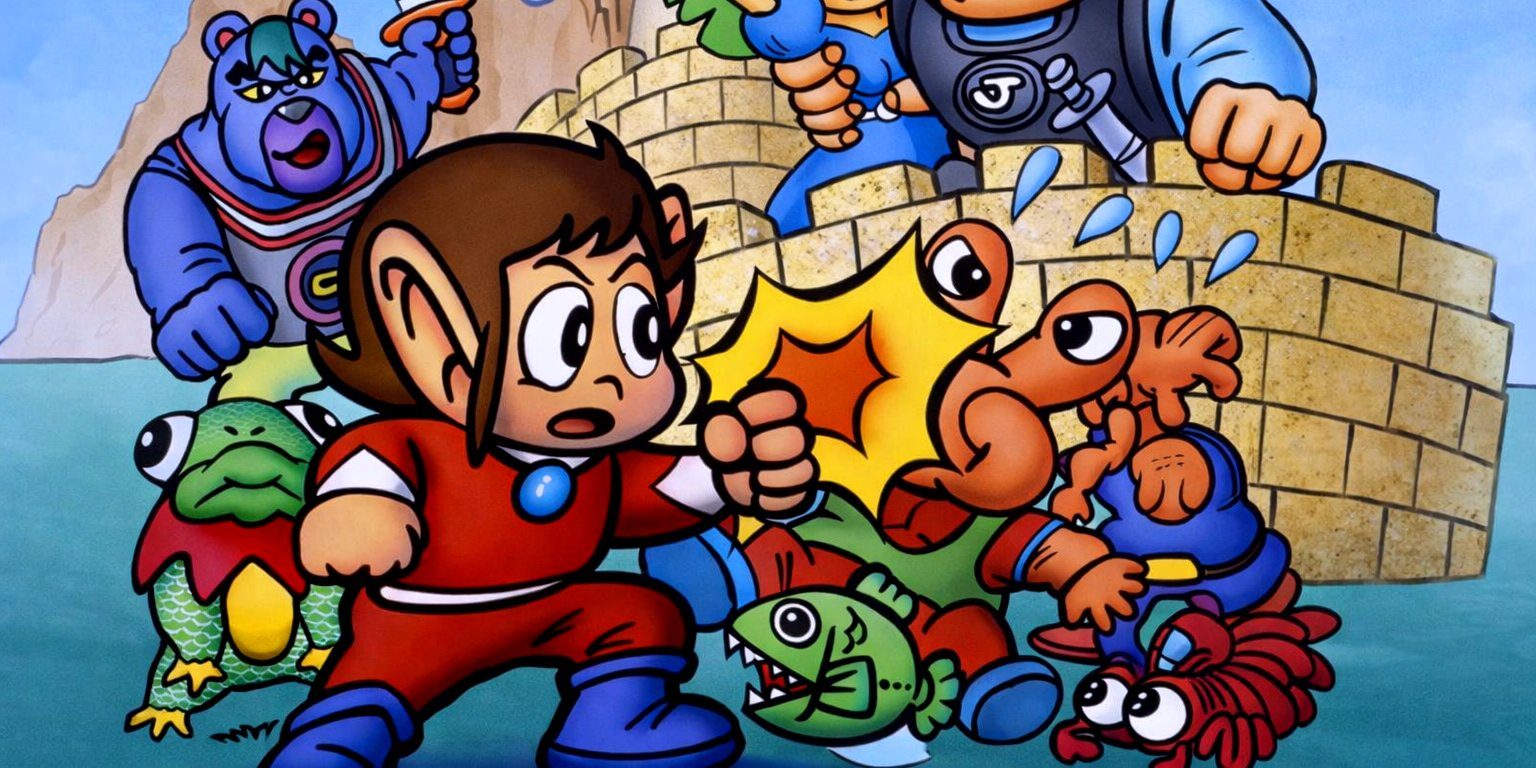
Kotaro Hayashida took the Shinkansen from Kyushu to Tokyo the morning after reading a jobs advertisement in a magazine. He got lost on the way to Sega’s headquarters, ended up at Factory No. 2, and was given a lift by an employee who ensured he arrived in time for his interview. Sega offered him an informal job that same day. He had also booked an interview with Namco. He cancelled it. Within three years, working under the pseudonym Ossale Kohta, he had shipped roughly ten games — Pitfall II, Ninja Princess, Pit Pot among them — before being handed the most consequential brief in the company’s young console history: build something that sells as well as Super Mario Bros.
The Dragon Ball Problem
This was not the ambition behind Alex Kidd in Miracle World. The project had started elsewhere entirely. Development had begun as a Dragon Ball licensed title, the lead character wielding Goku’s Power Pole and the world drawing on Toriyama’s imagery. Partway through, the Dragon Ball licence expired and Sega CEO Hayao Nakayama ordered the team to start from scratch. The Power Pole became a fist. Goku became a big-eared boy from the planet Aries who had spent seven years on a mountain learning to shatter rocks with his bare hands. Only then did Hayashida begin thinking about Mario — and only to find ways of moving in the opposite direction.
His countermeasures were specific, and in retrospect, revealing. Mario punches upward; Alex punches sideways. Mario collects coins for points; Alex collects Baums, an in-game currency he can spend in shops on vehicles and power-ups. The buttons were deliberately reversed from Nintendo’s layout — a decision Hayashida later described, with rueful honesty, as “just nonsense.” But the vehicle system, the inventory, the shops, the branching paths through scrolling and single-screen environments — these were not counter-programming. They were Hayashida’s genuine instinct toward something more expansive. He wanted a fusion: platform game, adventure game, action game, all folded into a single experience. Sega did not prescribe the design. He simply included every idea he had.
The setting he imagined was interstellar and oddly literary. The planet Aries, he said in a 2002 interview, evoked the great Central Asian city of Balkh in the time of Marco Polo — a crossroads of cultures, at once alien and recognisable. That tension threads through the whole game: Alex’s favourite food is onigiri, a Japanese rice ball, which Hayashida explained by noting that Alex’s father, King Thunder, had a passion for other cultures. The Western version of the game replaced the onigiri with a hamburger, silently smoothing over the same cultural gap the game had already embodied. The stone-and-jungle aesthetics of Radaxian, the rock-paper-scissors boss battles drawn from the Japanese schoolyard game of janken — in Japan, all of this had a self-evident logic. Outside Japan, it was simply vivid and strange.
"At the time we thought we were doing something 'different'… but we were mistaken. Now when I look back on it, it's just nonsense. And it's harder to play that way."
— Kotaro Hayashida, Sega.jp Meisaku Interview Series, 2002
Punching Money Out of Walls
What you are doing in Miracle World — for the roughly two hours it takes to finish, assuming no game-overs — is navigating a world that refuses to behave like a platformer should. The surface legibility is high: run right, punch enemies, jump across gaps. But every few screens the contract shifts. You drop into a shop and weigh the Sukopako Motorcycle against a Pedichopper. You step onto a map screen and feel the faint shape of a world rather than a level select. You enter a dungeon stage where the camera locks and the space becomes a puzzle, single blocks hiding either treasure or the malevolent ghost that erases a life on contact.
Nothing is telegraphed. The game extends no particular courtesy. Alex can absorb exactly one hit before dying, and there is no password, no save, no battery backup — only an undocumented continue hidden behind holding Up and pressing Button 2 eight times on the Game Over screen, which costs 400 Baums, which you must have already earned. Miracle World is, beneath its bright colours and onigiri, a game that demands you read it slowly and punishes you for rushing.
The pleasure is not comfort. It is the specific satisfaction of punching through a wall and finding something useful on the other side — the moment a corridor of indifferent blocks reveals itself as an economy. You start hoarding Baums, then spending strategically, then realising that the shop inventory changes your route through the world. The game is teaching you, but it will not tell you that it is teaching you. That is the contract.
Rock, Paper, Death
The moment its real character becomes apparent arrives not in the platform stages but at the boss encounters. After the orthodox work of a level — the timing, the block-breaking, the measured jumps — you reach a figure who offers you neither combat nor pattern recognition. You play rock, paper, scissors. Best of three. There is no information. No tell. Hayashida later admitted he included the janken battles to observe how audiences would react to something unusual, and acknowledged in hindsight that the disruption to game flow was a mistake. But the disruption is also precisely what separates Miracle World from everything around it. You arrive at the boss carrying all your competence, all your learned patience, and it counts for nothing. The game shrugs. You throw scissors. Janken throws rock. You die. You do the level again.
This is the thesis of Alex Kidd in Miracle World, stated plainly in its systems: the world does not reorganise itself around your skill. Hayashida built a game in which different registers of engagement coexist without smoothing into each other — the thoughtful navigation of a shop, the reflex-testing of a platform section, the pure chance of janken — and refused to apologise for the seams. Contemporary Mario was already constructing the grammar of the platformer, tutorialising through stage design, building the sense that mastery was always within reach. Miracle World offers no such reassurance. It is a game assembled from many games, unified by a boy with enormous fists and inexplicable taste in Japanese food, and the world it inhabits is larger and stranger and more indifferent than the platform section at the start suggested.
The Moment It Becomes Readable
There is a moment — usually somewhere after the early confusion has settled into cautious intent — where the game’s logic becomes legible. Not predictable, but readable. You begin to see which surfaces invite testing. Which enemies demand distance. When to conserve Baums and when to spend them. The janken encounters stop feeling arbitrary and start feeling like interruptions you prepare for rather than resist.
The world has not changed. You have. That shift is real, and it is the reward the article’s difficulty has been building toward. What was a hostile accumulation of unfamiliar rules resolves into something you can move through with purpose. The dungeon screens, the vehicle sequences, the shop decisions — they stop being obstacles and become the texture of a game that trusts you to figure it out. It is not a large game. But it is a complete one, and the completeness only becomes visible once you stop fighting its terms and start working within them.
You Can See the Joins
The game was released on November 1, 1986, for the Sega Mark III in Japan, arriving in North America in December and Europe in 1987. In Japan and North America it sold respectably but never threatened Nintendo’s dominance. The Master System sold only 125,000 units in its first four months in the United States, against two million NES consoles.
The calculation changed entirely when Sega decided to embed Miracle World directly into the hardware. From 1990, the game was built into Master System II consoles sold in Europe, Australia, Brazil, and beyond — no cartridge required, no purchase necessary. An entire generation of children in those markets encountered Alex Kidd not as a game they chose but as the game that was already there. In Brazil, the Master System’s cultural dominance persisted well into the 1990s. In parts of Europe, Alex Kidd was Sega — its character, its tone, its promise.
The sequel, Alex Kidd in the Enchanted Castle, arrived on the Mega Drive in 1989 and retreated from everything that made the original distinctive: the shop economy stripped back, the environmental variety narrowed, the strangeness buffed away. It was more conventional and considerably less interesting. The series effectively ended there, and in 1991 Sonic the Hedgehog rendered the question moot. Within a year, Alex had been retired. In the Dreamcast-era game Segagaga, he appears as a character who laments his demotion with a kind of rueful dignity — reduced to a cameo in his own company’s retrospective, but still there.
He returned properly in 2021, via a full remake developed by Jankenteam and published by Merge Games — the same publisher behind Streets of Rage 4 — that allows players to toggle between the original graphics and a new hand-drawn art style mid-play. Several members of the Jankenteam stated they had grown up preferring Alex Kidd as a mascot to Sonic. The remark lands differently depending on which side of the Atlantic you encountered the original. In North America, it reads as hyperbole. In Brazil, Portugal, or England’s back rooms with Master Systems gathering dust in 1992, it is simply the record of a particular childhood.
Today the game plays exactly as it always did — at once more interesting and less forgiving than you expect. The controls carry the slight mushiness of the era; the hit detection in the underwater sections still makes demands that feel disproportionate. The janken battles remain stubbornly random. None of this obscures what Hayashida actually built: a game wide enough to contain shops, vehicles, dungeons, interplanetary lore, onigiri, and pure chance within a single coherent — if seam-showing — world. He was in his mid-twenties and had been designing games for three years when he made it. He put everything in. He has never been entirely wrong to have done so.