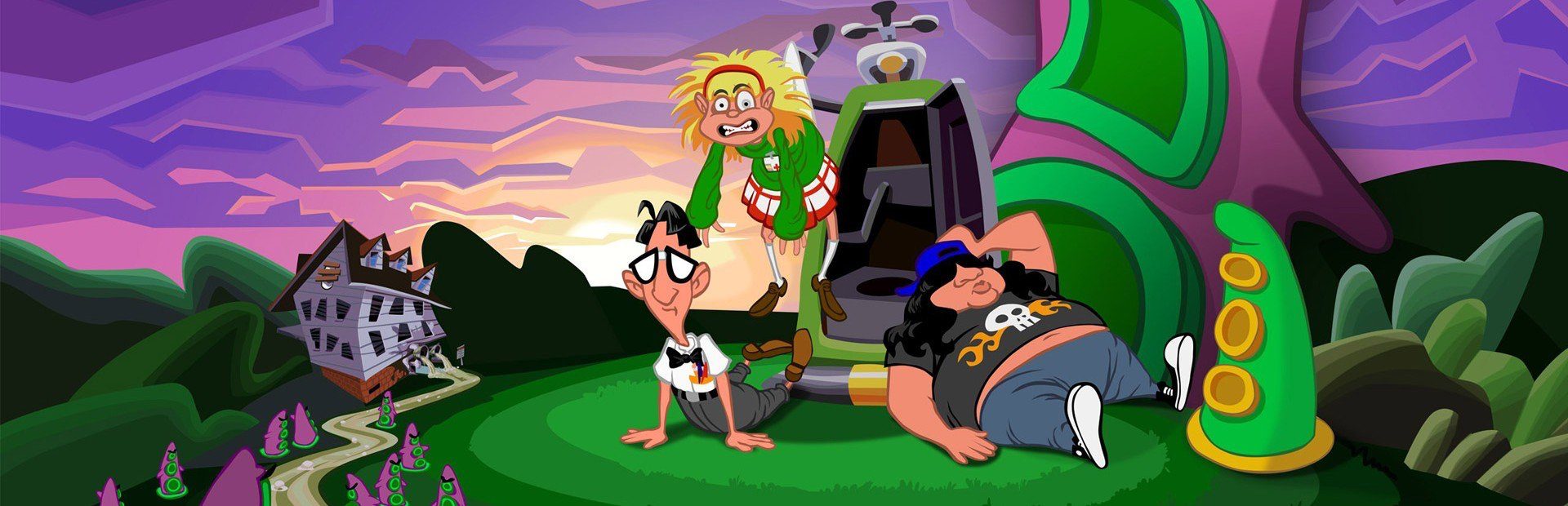
You do something in one century and find out what it means in another. That is the basic transaction of Day of the Tentacle, and nothing else in thirty years of adventure game design has built the same structure as cleanly or played it as fairly. Leave a bottle of wine in colonial America and it becomes vinegar in 1993. Send a hamster through a cryogenic freeze and retrieve it intact two centuries later. Rewrite the Constitution — by convincing the Founding Fathers, one at a time, to add a clause allowing non-humans to own property — so that a tentacle in the far future can legally check into a hotel room. Each solution follows from the same internal logic.
Tim Schafer and Dave Grossman spent four years as understudies to Ron Gilbert on the Monkey Island games, absorbing his philosophy: that a puzzle should never be unsolvable, that players should never be punished for curiosity, that adventure games should trust the person playing them. When Gilbert left in 1992, he handed them a rough outline for a Maniac Mansion sequel. Grossman later said they stopped thinking of it as a sequel almost immediately — and built something else entirely.
One Mansion, Three Centuries, One Ridiculous Plan
Three characters are separated across three centuries: Bernard in the present, Hoagie in colonial America where the Founding Fathers are drafting the Constitution, Laverne in a tentacle-dominated dystopia 200 years hence. All three share a single location — the Edison mansion, now a cheap motel — at different points in time. Every significant puzzle requires something passed between them.
The structural constraint they set themselves was demanding: every puzzle would operate across time, with actions in one era producing clear consequences in another. Grossman researched the period for historical grounding, visiting libraries and consulting reference librarians; the team took creative licence freely — the manual’s stated historical accuracy policy is that there isn’t one — but the underlying logic was never arbitrary. A throwaway gag late in the game — Bernard feeds $876,600 in quarters into a dryer to keep it running for 200 years — turns out to be arithmetically exact, accounting correctly for leap years across two centuries. The joke is also a precise calculation. That is the level the whole game is working on.
Chuck Jones Never Gave Them a Quote
Lead artist Peter Chan modelled the backgrounds on the work of Chuck Jones and Maurice Noble — specifically What’s Opera, Doc?, Duck Dodgers in the 24½th Century, and Rabbit of Seville; the characters were drawn with oversized heads and exaggerated expressions to allow for the kind of face-acting those cartoons depended on. The style is not decorative. A character whose face telegraphs intent across three time periods has to be readable at a glance — the cartoon exaggeration is part of how the cross-timeline logic stays clear.
Jones himself was brought to the studio during development to see a demo. He provided nothing usable. Schafer recalled: “We should have just come out and asked him for one. Still, it was fun hanging out with him.” The Computer Gaming World reviewer, when the game shipped, noted that Chuck Jones would have been proud regardless.
The Moment the Machine Clicks
What you are doing is maintaining a coherent model of three simultaneous timelines and asking what each one needs that the others can provide. You carry an object into the past and leave it; you return to the present and find it transformed. You read a document in the far future, understand its chain of causation, and work backward to the moment — two centuries earlier — where the chain can be interrupted or redirected.
The Chron-O-John, a modified portable toilet serving as the game’s time-travel mail system, accepts only small items. Larger problems require things left in the past to be discovered by the future rather than delivered through it. The pleasure is not the solution itself but the moment before it — when the three timelines suddenly snap into alignment and you understand how they fit, when a logic that seemed surreal reveals itself as completely, rigidly consistent.
There is a moment, early on, when you send an object back in time for the first time and watch the present change in response. Nothing is explained. The connection between action and result is yours to parse. In that moment you understand what you are actually playing: not a sequence of puzzles but a single interlocking machine, built across three time periods, whose operating logic you now hold in your head. Every subsequent puzzle is a variation on that same transaction. It never checks whether you’re keeping up.
Seven Diskettes for Germany
The game had been conceived as a floppy-disk-only release, voice acting never part of the plan. As CD-ROM penetration spiked through late 1992, LucasArts’s general manager Kelly Flock proposed adding full dialogue — which also gave the team more time to finish. It became the first LucasArts adventure with voice work on release: a cast assembled against character descriptions Schafer and Grossman supplied, recorded and then stripped back out again for the floppy version, which Grossman spent weeks compressing onto six diskettes by trimming individual sound effects by kilobytes at a time. The German version, with its longer text strings, got seven.
Day of the Tentacle sold approximately 80,000 copies on release — a moderate result that Schafer considered an improvement over the Monkey Island games, which had performed poorly despite their reputation. The LucasArts golden era, which peaked between roughly 1990 and 1998, would later acquire the status of a lost art form, mourned by designers who had grown up playing it and could not quite articulate why the form had died. The answer, partly, is that this kind of puzzle design requires a studio willing to spend significant time verifying internal consistency across the entire game’s solution space — checking that no single puzzle breaks another, that time travel consequences resolve correctly, that the machine doesn’t jam. It is expensive to build that way. Most studios stopped.
The Miracle Rights Negotiation
The remaster arrived in 2016, developed by Schafer’s studio Double Fine after he described the rights negotiation as a “miracle” — aided by the fact that executives at each step in the ownership chain had personal memories of playing the original and were willing to help. It is a generous piece of work: new hand-drawn art at modern resolutions, rerecorded audio, developer commentary from Schafer, Grossman, and the full original team, and the ability to toggle between the original pixel art and the redrawn graphics at any moment. The original Maniac Mansion is included, playable in full on a computer within the game world — a study in how much the design philosophy had shifted in six years, since Maniac Mansion allows player death and dead ends in ways its sequel explicitly refused.
The puzzle logic has not dated because it was never a product of its era. It is a product of its ambition. A new player today encounters the same machine Schafer and Grossman built — no dead ends, no deaths, no states from which recovery is impossible. Everything is already there, working exactly as designed.
The credits roll over an American flag whose design has been quietly, permanently altered by the chain of events you set in motion hours earlier. Not dramatically — just changed, in the way that anything changed at the source will be changed at the destination.