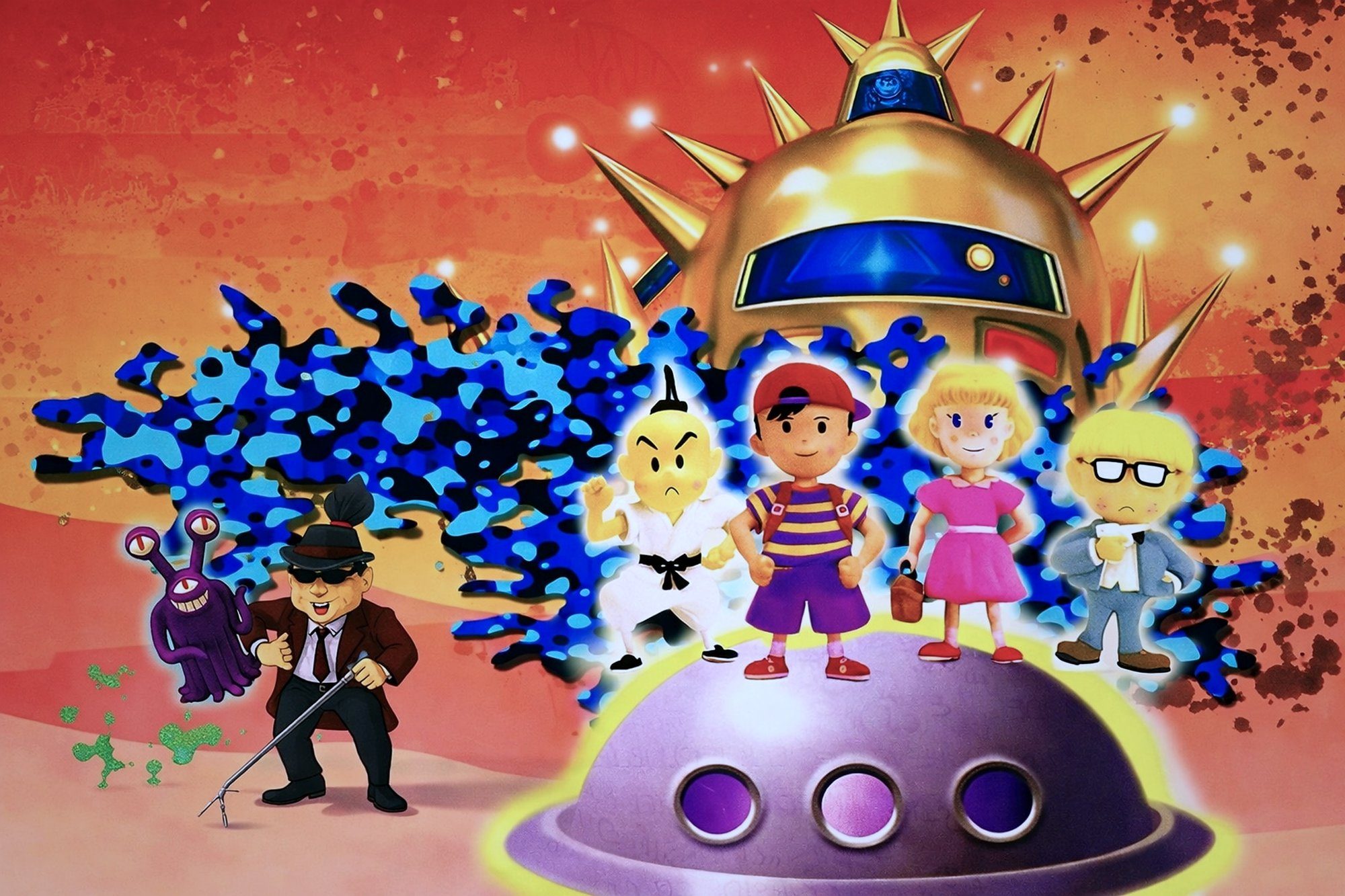
Shigesato Itoi was not a game designer. He was Japan’s most celebrated advertising copywriter — a television personality, an essayist, the voice of the father in Hayao Miyazaki’s My Neighbour Totoro. In 1987, a colleague introduced him to Dragon Quest on his Famicom, and while playing it, Itoi had an idea: a role-playing game set not in a medieval fantasy world but in the suburban present. Kids with baseball caps. Psychic powers. Shopping malls and ATMs and fathers who only ever call on the telephone. A world that looked exactly like the one outside the window — and that was, for that reason, far stranger than any dragon or castle could be. The familiar, made uncanny. That instinct is the game’s central achievement, and everything else in its strange history flows from it.
The Game That Nearly Died Twice
He pitched the idea to Shigeru Miyamoto. Miyamoto rejected it, citing the commercial failure of other celebrity-produced Famicom games. Nintendo’s president Hiroshi Yamauchi overruled him — Itoi’s instinct for strangeness, Yamauchi felt, was precisely the point. Development began — and then stalled, and very nearly didn’t recover. By its fourth year the project had expanded from an 8-megabit cartridge to a 24-megabit one, survived repeated threats of cancellation, and arrived at a point where the codebase was so tangled that progress had effectively stopped. The assets were complete. The scenario was written. Everything was there — except a game.
The man who fixed it was Satoru Iwata. Then president of HAL Laboratory, Iwata looked at the state of the project and delivered his assessment without ceremony: “If we use what you have now and fix it, it will take two years. If we can start fresh, it’ll take half a year.” He took the data back to HAL’s offices in Yamanashi, worked for a month, and returned with a scrollable field — the engine’s most fundamental element, running cleanly for the first time. The team was stunned. Iwata was puzzled by their reaction; he said he had only done the obvious. Six months after he joined, the game was playable from start to finish. They spent another six polishing. EarthBound shipped in 1994. Satoru Iwata later became Nintendo’s president.
"Normally, game characters are treated as though they're just parodies of people. In EarthBound, the characters are handled so well, and it made a great impression on me."
— Shigeru Miyamoto
Suburban America as Surrealist Canvas
What Iwata saved is worth understanding on its own terms. There is no overworld map — Itoi refused one, not wanting an artificial barrier between towns and the roads between them. You walk from place to place continuously, the game world seamless and unbroken. Enemies are visible on screen rather than random, meaning you choose your fights. And your health doesn’t drop instantly when you take a hit: it ticks down on a rolling counter, like an odometer unwinding, which gives you a few seconds after even a fatal blow to act — to heal, to run, to land one last strike. It makes combat feel like a sustained near-miss rather than a clean binary, and gives the whole game an undertow of controlled anxiety that its cheerful surface keeps partially concealed. Your enemies are called things like “New Age Retro Hippie” and “Annoying Old Party Man.” The soundtrack borrows from salsa, reggae, dub, and the Monty Python theme. The Mr. Saturn characters speak in a font drawn from the handwriting of Itoi’s daughter. For most of its length EarthBound is funny and warm and entirely charming. Then, in its final hour, the familiar turns on you.
The final boss, Giygas, is a cosmic horror without form — a swirling mass of red and black that the game tells you cannot be comprehended, whose attacks cannot be grasped, whose dialogue consists of fragments of pain repeated in loops. Itoi has said the confrontation was drawn from a traumatic childhood experience — walking into the wrong cinema and witnessing a scene of violence he misunderstood as rape, from a Shintoho film called The Military Policeman and the Dismembered Beauty. He described what he was trying to evoke as atrocity and eroticism side by side. The development team reportedly wept while typing Giygas’s lines from Itoi’s dictation. Few Nintendo games have ended anywhere near here, and it works precisely because the preceding thirty hours have made you completely unprepared for it.
The Campaign That Missed the Point
The American release in 1995 was a study in mismatch. Nintendo spent $2 million on a campaign built around the tagline “This Game Stinks” — full-page magazine ads with scratch-and-sniff inserts smelling of flatulence and stale pizza. The scratch tabs didn’t stay sealed in transit. Nintendo Power readers reported their mailboxes had been infected. The game sold 140,000 copies in North America, was declared a failure, and never received an official European release.
The Reversal
What followed was one of gaming’s great reversals. A community at Starmen.net kept the game alive through the late 1990s and 2000s — petitions, fan advocacy, a fifteen-year organised campaign. When Ness appeared in Super Smash Bros. in 1999, millions of players encountered the character without knowing his game. When EarthBound reached the Wii U Virtual Console in 2013, Satoru Iwata — by then Nintendo’s president — credited the fan community on Miiverse as the reason for the release. It arrived on Nintendo Switch Online in 2022, legally available in Europe for the first time. Undertale, Omori, and a dozen games after them learned from what Itoi built: that the world you know, refracted just slightly, is the most unsettling world of all. You don’t need dragons. You need a boy in a baseball cap, a telephone that never rings back, and thirty hours before the familiar finally breaks.
Platform: SNES (1994 JP · 1995 NA · never officially released in Europe until 2022)
Best played: Nintendo Switch Online — finally, legitimately, in Europe for the first time. The game is exactly as it was in 1994, which is exactly right.
Time to complete: 25–35 hours · the pacing is generous without being slack; it rarely demands grinding, and the game moves on its own quiet logic.
Why now: Because Undertale, Omori, and a dozen other games you may already love are direct descendants of this one — and understanding the source changes how you hear the echoes. Because Shigesato Itoi had no business making it and made something irreplaceable. And because it is finally, thirty years late, available to the audience it always deserved.