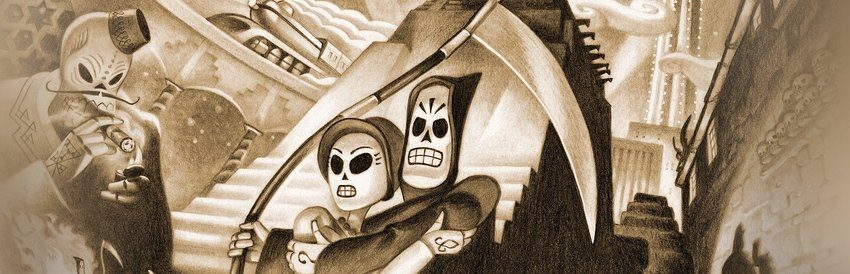
The elevator pitch should not have worked. A point-and-click adventure game set in a retro-futuristic Aztec afterlife, styled after 1940s film noir, starring a skeleton travel agent in a pinstripe suit named Manuel Calavera.
It works because Grim Fandango is not a collage. It is a single, deliberate world — one that does not wait for you to understand it.
You arrive in the middle of things. Conversations are already happening. People finish them without you. They turn away, walk off, continue lives that don’t hinge on your input. The Department of Death processes souls whether you intervene or not. Manny is not the centre of this place. He is caught inside it.
The Pitch That Shouldn’t Have Worked
The idea had been forming since his college years, when anthropology courses introduced him to Mexican folklore and a Day of the Dead art book showed him calaca skeletons — papier-mâché figures whose bones were painted on the outside. He looked at their simple shapes and thought: texture maps. Then he attended a local film noir festival and something clicked. Raymond Chandler in the Land of the Dead.
What matters is how completely the game commits to it.
The Department of Death is a bureaucracy first and a setting second. Souls arrive, are assessed, and assigned travel based on the virtue of their lives. Those who lived well are meant to receive express passage. They don’t. Tickets are intercepted. Routes are manipulated. The system is already compromised.
The spaces reflect that same intent. Art Deco towers sit beside bone-white forests and rusted ports, each location carrying its own visual language. What holds them together isn’t style, but attitude — a consistency of tone that allows wildly different environments to feel like parts of the same world. These places weren’t built around puzzles. The puzzles were fitted into them.
Manny’s problem is not that something is wrong. It’s that something has been wrong for a long time, and he’s only just noticed.
"While its reputation as a flop isn't entirely accurate, Grim's sales were either an indication that people preferred motorbikes to Gitanes-smoking corpses, or a sign of the times: adventure games were simply on their way out."
— Edge, 2009
Four Years and One World
What Schafer and his team produced across three years of brutal, protracted crunch — months of sixteen and eighteen-hour days — was a four-act structure of genuine novelistic ambition.
Across four acts, the game jumps forward in years. There is no transition, no ceremony — just a hard cut and the quiet realisation that time has passed without you. Manny moves through a corrupt city, a rain-soaked harbour, an industrial frontier, and finally a capital where the system reveals itself. Each space feels like a different story already in progress.
People have changed when you return to them. Some have moved on. Some have hardened. Some are gone.
You don’t shape these events. You arrive after they’ve begun.
The writing — produced largely by Schafer himself — carries that structure. Dialogue crackles with the wit and moral weight of the crime fiction it draws from, but it also does something quieter: it remembers. A line you barely register early on returns hours later with consequence. A background detail becomes a solution. The game doesn’t just reward attention — it keeps track of it.
The score deserves its own sentence. Composed by Peter McConnell, it weaves Cuban jazz, mariachi, and smoky big-band arrangements into something entirely its own — less accompaniment than atmosphere, reinforcing the sense that this world exists beyond the player’s immediate view.
The Year Everything Changed
The change wasn’t just structural. It was foundational.
LucasArts abandoned the SCUMM system that had defined its adventure games and replaced it with something closer to film language — 3D characters, fixed perspectives, staged spaces. Manny doesn’t point at the world. He moves through it. The camera places you rather than follows you.
The puzzles remain — inventory, dialogue, progression — but they no longer lead. Writing does. Framing does. Movement through space does. Grim Fandango doesn’t evolve the adventure game. It quietly reorders it.
Released in October 1998 — alongside Half-Life, Metal Gear Solid, and The Legend of Zelda: Ocarina of Time — it arrived at a moment the genre could not survive. It sold respectably, but the conditions that sustained adventure games were already disappearing. Retail space was shrinking. Player expectations were shifting.
The problem wasn’t simply timing. It was identity. Grim Fandango didn’t fit what the genre had been, and it didn’t align with what games were becoming.
LucasArts never returned to it.
The Remaster Gets It Right
The original release carried friction — control schemes, visibility, technical limits.
The 2015 remaster removes most of it without altering the structure. Point-and-click controls restore clarity. Lighting improves readability. Audio sharpens performance. Commentary reframes intent.
It doesn’t modernise the game. It makes it legible.
Playing it now, the unevenness is still there. Some puzzles resolve with precision; others resist clarity and force you forward without certainty. But the balance is clear. You don’t solve problems to win. You solve them to stay — to hear the next line, see the next room, follow Manny a little further into something already in motion.
The world holds.
Platform: PC (1998) · Remastered 2015 — available on PC, PS4, Switch, Xbox One, iOS, Android
Best played: The remastered version without hesitation — restored audio, proper point-and-click controls, and director’s commentary that is worth hearing alongside the game itself.
Time to complete: 12–16 hours across four acts.
Why now: Because it creates something few games attempt — a world that does not depend on you, and invites you to stay anyway. Once you’ve seen that, it becomes difficult to return to games that wait for you to act.