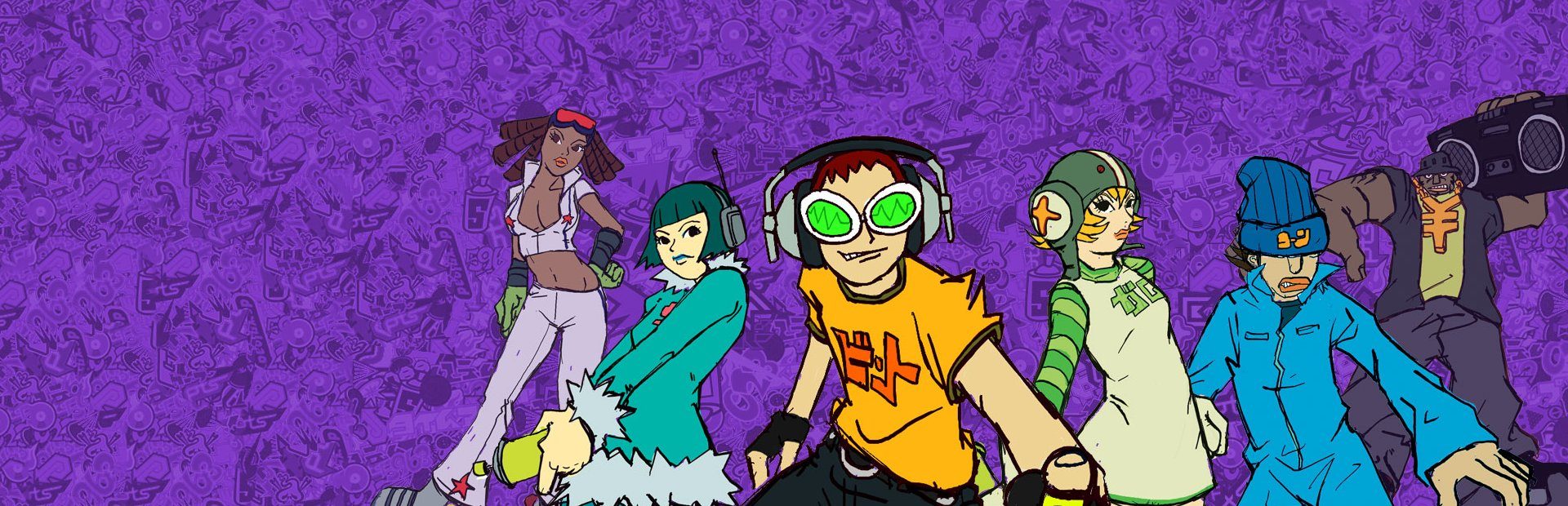
Jet Set Radio
The City Is a Canvas
The premise is deceptively simple. You are a rudie — a rollerblading teenager in a near-future Tokyo governed by a corporate police state — and your weapons are inline skates and spray cans. You grind rails, tag walls, outrun the cops, and reclaim your neighbourhood one luminous brushstroke at a time. Jet Set Radio is a game about graffiti as an act of freedom, and what it figured out — which almost nothing since has matched — is that movement, music, space, and rebellion can be made to feel like the same thing.
What it gives a player in 2026 that most games still do not: a specific, intact sensation. The movement is expressive rather than merely efficient — linking grinds, jumps, wall-rides, and tags into a run that feels half-sport, half-performance. The city is built to be read as flow, its rails and rooftops resolving into routes as you learn them. The music does not decorate the action; it creates its pulse. And the act at the centre — marking space, claiming presence, escaping authority — still feels mischievous and alive in a way most games have never attempted.
A Game That Still Looks Like Itself
The game holds a Guinness World Record as the first to use cel-shaded graphics — a technique developed by Smilebit’s art director Ryuta Ueda in deliberate reaction against the photorealism trend consuming the industry. Thick black outlines, flat colours, exaggerated shapes: it looks like a moving comic panel, and the choice still reads instantly today. There is no decay here. Where photorealistic games from 2000 look like failed approximations of reality, Jet Set Radio looks exactly like itself. Smilebit even tried to make the game technically impossible to duplicate on PlayStation 2 — pushing the Dreamcast’s colour output past what Sony’s hardware could manage. The aesthetic was not decoration. It was ideology.
"We wanted to construct something dealing with pop culture and something that was cool."
— Masayoshi Kikuchi, director
The City as Playground and Battleground
The influences were openly declared. The team cited PaRappa the Rapper, Fight Club, and 1980s American hip-hop graffiti culture. The in-game graffiti was designed by real artists — Eric Haze, who had created album art for the Beastie Boys and Public Enemy, among them. The settings were photographed from Shibuya and Shinjuku. These references matter not as trivia but because they shaped how the city feels: authored, specific, politically alive. You are not moving through a neutral obstacle course. You are contesting space that someone else claims to own.
The game’s friction is real and worth naming. The camera can be awkward on tight turns; tagging sequences sometimes break rhythm at the worst moment; the escalating police response — from beat cops to SWAT teams to a full military pursuit — can tip from thrilling to punishing without obvious cause. A modern player will feel these edges. But the friction is not incidental. It is part of the argument. The game earns its moments of pure flow by making you work for them, and the sensation of a clean run — lines, rails, walls, tags, evasion, all stitched together — is proportionally more satisfying for the resistance preceding it.
Let Mom Sleep
Composer Hideki Naganuma assembled a soundtrack that has no clean genre — hip-hop, J-pop, funk, acid jazz, trip-hop, arrangements that defy categorisation. It is the only word for what it does to the game: the music and the movement synchronise until the whole experience has a rhythm, a pulse, an attitude that belongs entirely to itself. Naganuma has said that Jet Set Radio and its sequel were his favourite projects of his career. In 2023 he revealed he had received multiple approaches to make a sequel — none came to fruition. “Maybe Sega knows,” he said. The wound runs deep even for those who made it.
The 2012 HD remaster removed two tracks for licensing reasons. It is a real loss for purists, but the remaining soundtrack still hits hard enough that the game holds. It is available on Steam. The Y2K aesthetic has returned as a cultural reference point, but this is not a museum piece to be visited for its era — it is the source of a sensibility that later games approximated without fully understanding. Wind Waker, Sly Cooper, Viewtiful Joe, and Sunset Overdrive all owe it a direct debt; the 2023 spiritual successor Bomb Rush Cyberfunk demonstrates, affectionately, how much of what made the original irreplaceable was never fully decoded.
Pressing play on Let Mom Sleep still feels like someone opening a window in a city that needed the air. The game underneath that music is worth your time not because it was first, not because it was influential, but because it still does something very few games have bothered to attempt: it makes you feel like the city is yours.
- Jet Set Radio — Wikipedia Wikipedia
- Jet Set Radio: Grinding the Cutting Edge of Cool for 25 Years BFI, 2025
- Jet Set Radio — JetSetPedia JetSetPedia
- Jet Set Radio — Complete Encyclopedia Shapes