Little Samson
The Bell at the End of the World
There is a version of history in which Little Samson is a household name. In that version, a Taito marketing executive in 1992 makes a different decision, prints more cartridges, spends money on advertising, and the game lands with the impact its quality warranted. Instead, we got the version we have: a game so obscure that a complete boxed copy now commands nearly six thousand dollars on the collector’s market, and a factory-sealed one approaches twenty thousand. Almost nobody bought it when it was new. Almost nobody has played it since.
The Game Behind the Rarity
This is a genuine loss, and it has almost nothing to do with the game itself. Little Samson was developed by Takeru — a small studio whose founding story is one of the more remarkable in the industry. Takeru was co-founded by Akira Kitamura, who had left Capcom after directing the first two Mega Man games and designing the character himself. Keiji Inafune — commonly credited as Mega Man’s creator — has said publicly that when he joined the project, Kitamura’s design was already finished. It is Kitamura’s game. He left Capcom seeking creative freedom, brought a group of ex-Capcom and ex-Irem designers with him, and in fourteen months Takeru made three games. Little Samson was the third and last before the studio went under. Director Shinichi Yoshimoto, who had worked on Ghouls ‘n Ghosts and Strider at Capcom, carried that lineage into every frame. The combat is precise. The level design is generous without being indulgent. The boss encounters are spectacular — huge, expressive creatures that dwarf the player in ways the NES hardware had no business producing in 1992. This is what a decade of Capcom discipline looks like when a team is finally free to make exactly the game they want, with no studio overhead and nothing left to lose.
"A tour de force of excellent game design, attractive graphics and pure entertainment value — one of the best games for the NES."
— AllGame
Four Weapons, One Design Philosophy
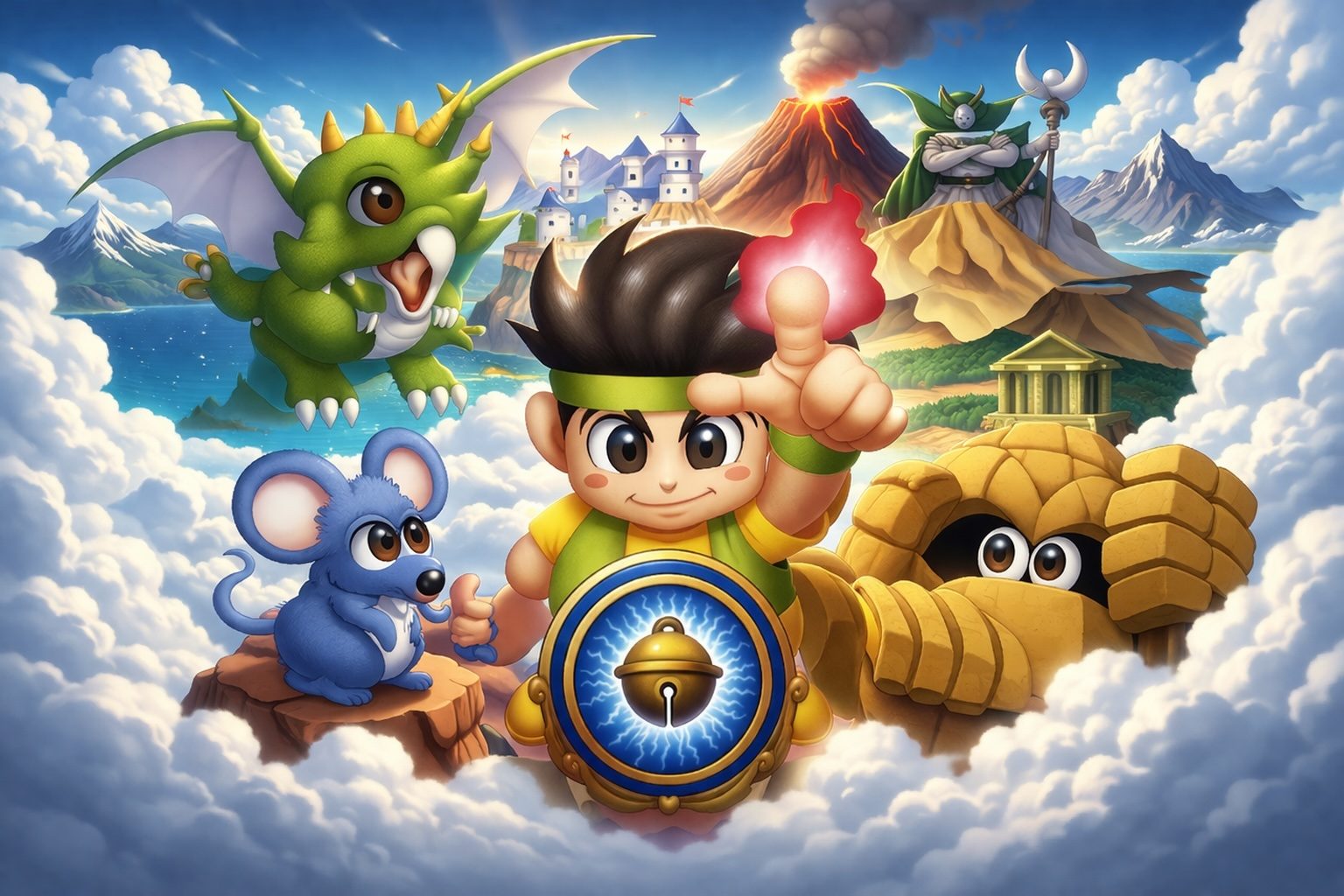
The structure is elegant. Four heroes — Samson the bell-wielder, Kikira the dragon, Gamm the living stone golem, and K.O. the bomb-setting mouse-wizard — each introduced across their own opening stage before becoming freely interchangeable. The game can be completed with Samson alone, but the real pleasure is in reading each encounter and selecting accordingly: the dragon for aerial sections, the golem for absorbing punishment, the mouse for threading through tight passages no one else can navigate. It is a character-switching system that feels ahead of its time, and it sustains interest across a playtime short enough to respect yours.
How a Great NES Game Gets Lost
The game’s commercial failure has a tragicomic explanation. In Japan it was known as Seirei Densetsu Lickle — Holy Bell Legend — a title that captures its spirit precisely. For Western release, Taito renamed it Little Samson. It has been reasonably speculated that American buyers, browsing NES shelves in late 1992 with the SNES already on the market, saw the word “Samson” and assumed a biblical edutainment title — a category reliably associated with some of the worst games ever made. Taito produced perhaps ten thousand copies. They sold poorly. The cartridges sat. The studio dissolved.
The rights situation became its own strange coda. For decades, nobody was entirely sure who owned Little Samson. When Limited Run Games set about arranging a re-release, they contacted Taito — who suggested the rights “might be with the owner.” They tracked down the owner. The owner did not know they held the rights. The trail ended there. Limited Run eventually reached the game through a provision of Japanese copyright law — Article 67-2 of the Japan Copyright Act, which permits the Agency of Cultural Affairs to license orphaned works whose owners cannot be located, holding the royalties in escrow in the event that someone eventually surfaces to claim them. A handful of other publishers have used the same mechanism to rescue games that would otherwise remain legally inaccessible forever. The game is finally coming to Nintendo Switch, PlayStation 5, and PC in 2026, thirty-three years after it quietly arrived and departed. It is, in its way, the most NES story possible: a masterpiece that slipped through every crack available to it, finally being hauled back into the light by sheer force of retroactive appreciation — and, in the end, by an obscure clause in Japanese intellectual property law.
Platform: NES (1992) · Re-release via Limited Run Games coming to Switch / PS5 / PC, 2026
Physical copy: Cartridge only ~$400 complete boxed ~$6,000
Best played: Emulation is your friend here and carries no shame whatsoever. This is one case where the game and the cartridge have become entirely separate propositions.
Time to complete: 3–5 hours · short, sharp, satisfying.
Why now: Because a generation of players who grew up on Mega Man and never heard of this game owe it to themselves to find out what Capcom’s best people did when nobody was watching. And because in 2026, for the first time in thirty years, you will finally be able to buy it legitimately — for considerably less than twenty thousand pounds.
- Little Samson — Wikipedia Wikipedia
- Little Samson — HG101 Hardcore Gaming 101