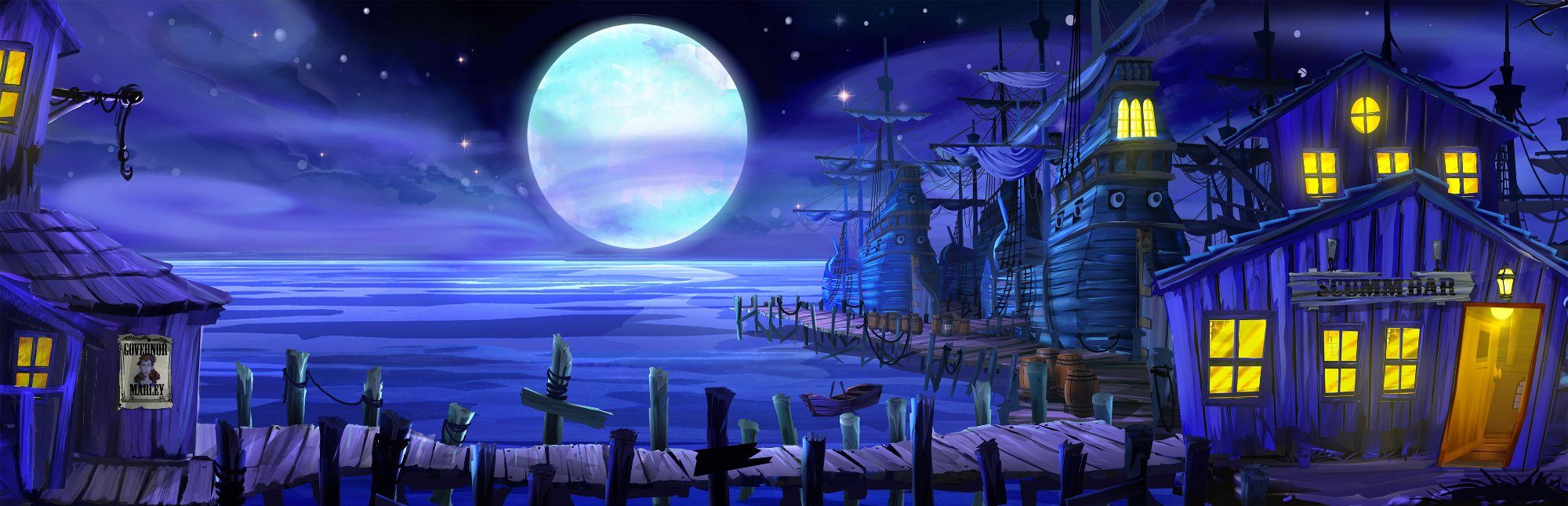
The Secret of Monkey Island
You Fight Like a Dairy Farmer
There is a Disneyland ride that Ron Gilbert never wanted to leave. The Pirates of the Caribbean keeps you in your boat — it moves you through the scene whether you want to linger or not, past the burning port and the auction block and the sleeping dog by the jail keys, and then it deposits you back at the exit. Gilbert described exactly what he wanted instead: step off the boat, wander the docks, find a way onto those pirate ships. That desire — to inhabit rather than observe, to have a world hold still long enough that you can puzzle your way through it — is the entire emotional logic of The Secret of Monkey Island. The game is a world made patient, and its thesis is that patience, properly designed, is a form of generosity.
The Ride, the Novel, and the Manifesto
Gilbert conceived the game in 1988, after finishing Zak McKracken and the Alien Mindbenders, sketching pirate story ideas at a friend’s house over a weekend. The atmosphere would come from the ride. The substance came from elsewhere: Tim Powers’ 1987 fantasy novel On Stranger Tides, which Gilbert has since described as his true inspiration — the source of the voodoo framework, the ghost pirate antagonist, the Caribbean rendered as a place where the supernatural is simply another feature of the world. On his blog, Gilbert corrected years of received wisdom: the ride was for ambiance, he wrote, but On Stranger Tides was where Guybrush and LeChuck actually came from. The game was built on two borrowed worlds and one original argument about design.
That argument had a name. In December 1989, with Monkey Island already in development, Gilbert published “Why Adventure Games Suck” in The Journal of Computer Game Design — a catalogue of everything that made him furious about the genre he was working in. Arbitrary deaths. Puzzles with solutions visible only in hindsight. Dead ends that could only be discovered after it was too late to recover. The Sierra model, in which falling into the wrong screen could strand you dozens of hours later in an unwinnable state, was not difficulty: it was punishment for curiosity. Gilbert named each sin with the precision of someone who had already decided what the opposite should look like. The Secret of Monkey Island is that document made playable. Every complaint in the essay is something the game refuses to do.
"We had to have some sort of sword fighting in a pirate game, but I didn't want to do a twitch-type game, and that's where the insults worked perfectly — because now the sword fighting became puzzle-solving."
— Ron Gilbert, Retro Gamer magazine, issue 212
The Fight That Isn’t a Fight
The insult swordfighting sequence crystallises this completely. Gilbert gathered the team to watch Errol Flynn pirate films for inspiration and noticed something: the fights were really about the talking. The insults. The barbs thrown between parties before any blade connected. A pirate game needs sword combat, but combat is a reflex game, and reflexes reward a different skill than everything else in Monkey Island. So the combat became language. You duel by selecting comebacks from a repertoire you must first learn — wrong responses lose the exchange, and the Swordmaster of Mêlée Island throws insults your existing vocabulary doesn’t cover, so you must fight ordinary pirates to build your knowledge before facing her. The system is a puzzle wearing the costume of a fight. Many of the insults were written by Orson Scott Card during a visit to Lucasfilm’s offices at Skywalker Ranch; his daughter Emily contributed the line that became the most famous of all.
Playing Monkey Island, you move through three simultaneous puzzles — the Three Trials that will confirm Guybrush a proper pirate — and the game never locks you out of forward motion. Stuck on the sword fighting, wander the docks. Stuck on the treasure hunt, try the prisoner in the town jail again. Gilbert mapped every puzzle on dependency charts — long logical chains where each solution unlocks the next, but never requiring one specific action before you are allowed to think about anything else. The freedom is structural, not cosmetic. Where contemporary adventure games made curiosity dangerous, this one makes it the entire point.
A Comedy Novel Where You Are the Protagonist’s Hands
What you are doing, for the eight to twelve hours the game takes, is reading a comedy novel in which you are also the protagonist’s hands. The prose comes through dialogue trees: Stan the Used Boat Salesman negotiates with frantic enthusiasm, the three pirates at the SCUMM Bar are magnificently unhelpful, and Guybrush himself — a good-natured fool who knows nothing about piracy and makes no pretence otherwise — earns his victories through persistence and an ability to think sideways. Root beer defeats the ghost pirate LeChuck. A rubber chicken with a pulley in the middle crosses a gorge. The logic is lateral but internally consistent, and when a solution arrives it feels discovered rather than arbitrary. The humour holds because it operates on character and situation rather than reference; a joke about Guybrush’s specific incompetence lands in 2025 as well as it did in 1990.
The game cost $200,000 and took nine months to make. It sold, according to Dave Grossman, somewhere north of 100,000 copies and far south of a million — a modest hit in the United States that became, per Next Generation, a blockbuster on the PC and Amiga throughout Europe. Its development team — Gilbert, Tim Schafer, Dave Grossman — went on to define a decade of the genre between them. Schafer made Day of the Tentacle, Full Throttle, Grim Fandango. Gilbert left LucasArts after the second Monkey Island, and the series continued without him for three more instalments across thirty years, accumulating a mythology that kept returning to one unanswered question: what is the Secret? Gilbert answered only in 2022, after completing Return to Monkey Island: the game had been set inside a pirate-themed amusement park the entire time. Guybrush, all along, was someone who could not bring himself to step off the ride.
The 2009 Special Edition allows you to toggle between redrawn art with full voice acting and the original 256-colour VGA graphics with a single keypress — mid-scene if you want. It is an unusually honest piece of preservation: two versions of the same game, neither superseding the other, both available to anyone who wants to know what the difference feels like. Most classics don’t offer this choice. Monkey Island offers it because the original already knew exactly what it was doing, and the remake is confident enough to let that show.
- The Secret of Monkey Island — Wikipedia Wikipedia
- Why Adventure Games Suck — Ron Gilbert, 1989 GrumpyGamer
- On Stranger Tides — Ron Gilbert, 2004 GrumpyGamer
- Monkey Island, or the Pirates of the Caribbean — The Digital Antiquarian The Digital Antiquarian
- Monkey Island creators recount the making of a classic GamesRadar
- Insult Sword Fighting — Monkey Island Wiki Monkey Island Wiki
- The Complete History of Monkey Island Time Extension
- Ron Gilbert Confirms the Secret of Monkey Island GGRecon