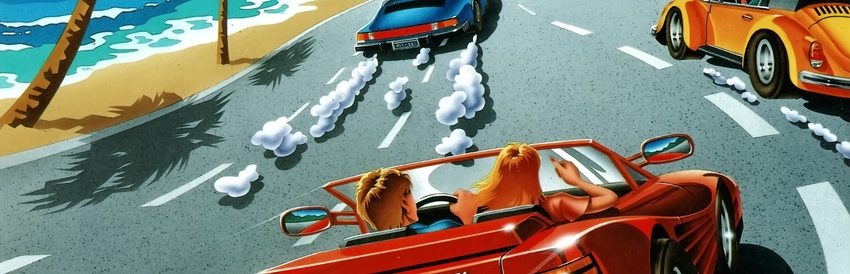
OutRun
The Open Road and Nothing Else
It Does Not Ask You to Win
Most driving games ask you to prove something. Be faster than the field. Hit the perfect line. Treat every mistake as a small personal failure. OutRun asks for something else. It gives you a Ferrari Testarossa, a passenger in the seat beside you, three songs on the radio, and a road that keeps dividing toward places you will not fully see in a single run. There is traffic to avoid and a timer to beat, but the sensation is not rivalry. It is momentum.
"OutRun asks for something else. The sensation is not rivalry. It is momentum."
That still feels unusual. Modern racing games offer more cars, more systems, more realism, more things to tune, customise, and optimise. OutRun offers a sharper answer to a simpler question: why did anyone want to drive in games in the first place? Not to manage a garage. Not to complete a season. Not to shave tenths from a qualifying lap. To move. To feel speed as liberation. To have the horizon keep arriving.
That is the real reason to play OutRun now. Not because it is historically important, though it is. Not because it influenced half the genre, though it plainly did. Play it because very few games understand pleasure this clearly. Within seconds, it establishes a complete fantasy: speed without heaviness, danger without cruelty, choice without complication, music that changes the colour of the journey.
The Key Design Decision Was Mercy
Yu Suzuki understood something many arcade designers of the period did not: difficulty is not the same thing as tension. He later said that earlier driving games tended to have cars “explode when they came into contact with each other,” whereas for OutRun he wanted “a game where recovery is possible” — something “more tolerant, less serious.” That instinct shapes everything. In OutRun, a mistake hurts, but it does not usually kill the run outright. You lose speed, rhythm, and precious seconds. Then the car settles. You gather yourself. You accelerate again.
That matters more than it first appears. Plenty of arcade games from the mid-eighties are still admirable, but no longer especially inviting. They are brittle. They punish curiosity. They are designed to make you start over before you have properly entered their world. OutRun is different. It wants you under pressure, but it also wants you to stay in the fantasy. The point is not flawless execution. The point is whether you can recover your flow quickly enough to keep the dream alive.
"The point is not flawless execution. The point is whether you can recover your flow quickly enough to keep the dream alive."
That generosity is a large part of why the game still feels good in the hands. The controls are responsive without being twitchy. The car drifts just enough to feel glamorous rather than technical. Traffic creates hazard, but also texture. You are not threading through a sterile course. You are negotiating a road in motion. OutRun does not chase realism, yet it understands a truth about driving games that many later simulations forgot: exhilaration depends as much on forgiveness as precision.
Five Minutes, Five Routes, A Whole Journey
The structure is simple enough to explain in a sentence. Each stage ends in a fork. Left or right. Choose quickly, and the scenery changes. Over five stages, those choices carry you toward one of several endings.
But the brilliance of OutRun lies in how much that small structure implies. There is no campaign map, no branching dialogue, no grand statement of consequence. The choice happens in motion. You commit, the road bends, and suddenly the run has a different tone. A short arcade game begins to feel like travel. Not travel as geography, exactly, but travel as mood: coastal ease, desert glare, alpine danger, the sense that a turn taken at speed can alter the shape of the day.
"A short arcade game begins to feel like travel."
This is one of the game’s great tricks, and one of the main reasons it remains worth returning to. The routes are not deep in a modern systemic sense. They do not need to be. They create variation without friction. Repetition feels like return, not labour. A strong run lasts only minutes, but the branching ensures that the game always suggests more road than it can show in one sitting. That suggestion is part of the fantasy. OutRun is small, but it feels open.
Not a Racer. A Holiday Dream
The usual way of writing about OutRun is to call it a racing game and move on. But that misses the thing that makes it distinct. It is not really about racing in the conventional sense. There is no proper pack battle, no jockeying for position, no circuit logic, no obsession with first place. It is a driving game in the purer and stranger sense: a game about sustained movement through attractive space.
Everything supports that idea. The road rises and falls dramatically. The backgrounds are broad, bright, and simplified, less interested in realism than in atmosphere. Palm trees, open skies, glowing coastlines, sudden shifts in terrain: the world is a postcard rack in motion. Even the Ferrari is less a vehicle than a symbol. It does not need to be believable. It needs to feel like the right car for a life briefly unburdened by consequence.
This is where the game’s age almost helps it. Because the hardware could not chase realism, Suzuki and his team had to chase sensation instead. The result is cleaner than many later driving games with far greater technical means. OutRun understands that movement can be seductive before it is competitive. That speed can feel romantic. That a road can be exciting simply because it keeps unfolding.
"OutRun understands that movement can be seductive before it is competitive."
The Music Changes the Meaning of the Road
Few games have ever done more with music selection at the start than OutRun. “Magical Sound Shower,” “Passing Breeze,” and “Splash Wave” are not just excellent tracks. They are mood selectors. They tell you what kind of drive this is going to be.
Choose one, and the road feels bright and playful. Choose another, and it turns softer, smoother, more wistful. The route itself has not changed, but the emotional charge has. That is a remarkable achievement for such a small system. In most games of the period, music decorates action. In OutRun, it defines the emotional frame around it.
That remains a large part of the game’s charm. The soundtrack is not memorable because it is merely catchy, though it is. It is memorable because it is inseparable from the fantasy. You are not just steering a car. You are selecting the tone of your escape. The songs do not sit behind the experience. They author it.
It is difficult to think of many driving games since that have understood this quite so cleanly. Modern racers license dozens of songs and build radio stations and playlists and streamer modes. OutRun asks you to pick one track before the engine even settles into your hands, and somehow makes that choice feel more personal.
The Road It Left Behind
OutRun was not just a hit. It left behind a way of thinking about driving games that the medium has never fully abandoned. Not the competitive branch, not the simulation branch, but the more elusive one: driving as sensation, fantasy, and escape. Speed not as domination, but as pleasure. Scenery not as backdrop, but as part of the appeal. Music not as accompaniment, but as emotional architecture.
That idea proved larger than the original game. Sega returned to it repeatedly, sometimes directly, sometimes by implication. Turbo OutRun, OutRunners, and later OutRun 2 all understood that the core appeal was never merely the Ferrari or the cabinet. It was the feeling of movement without heaviness: the road unspooling ahead, the landscape changing around you, the sense that driving could be stylised into a kind of playable daydream.
Its influence also escaped the series. You can see traces of OutRun anywhere a driving game values mood as much as mastery: in arcade racers that care about drift and spectacle over realism, in games that treat music as part of the vehicle fantasy, in the long afterimage of sunlit coasts, neon skies, and immaculate cars moving through a world designed less as a simulation than as an invitation. Even the modern use of “outrun” as a retro-futurist aesthetic says something revealing. Very few games lend their name not just to sequels or imitators, but to a whole visual mood.
That afterlife matters because it clarifies what was always special about the original. OutRun did not endure simply because it was technically impressive in its moment, and not only because its cabinet became iconic. It endured because it found a clean, durable idea inside driving and expressed it so confidently that later games kept circling back to it. The road it opened was never just about racing. It was about longing.
A Fantasy of Its Time
The development story matters only insofar as it explains why the game feels so specific. Suzuki had originally imagined something inspired by road movies and American car culture, but the research trip that shaped the game took him and part of the team through Europe instead. That helps explain why OutRun does not feel like a documentary view of anywhere. It feels like luxury travel reduced to image and desire: Mediterranean light, impossible leisure, a red sports car moving from one idealised horizon to another.
That fantasy is obviously of its time. The glamorous blonde passenger is less a character than an accessory, part of the game’s soft-focus eighties image-making. The tone is all aspiration, surface, and untroubled motion. You can see the limits of that immediately.
But what has lasted is not the pose. It is the clarity of the wish underneath it. OutRun understands something very basic and very durable: that driving, in games, is often less about competition than about escape. Escape from place, from routine, from weight. The fantasy remains legible because the underlying desire remains legible.
What Has Aged, and What Hasn’t
The sprites are small. The environments are abstract. The collision model is not interested in plausibility. If you come to OutRun looking for sim handling, technical track design, or the texture of real motorsport, you will obviously find none of it here.
But those are not the things the game was built around, and they are not the things that have kept it alive. What has aged well is the design underneath the presentation. The route structure still works. The timer still generates pressure without panic. The handling still encourages commitment rather than caution. The pacing still gives each run an arc: opening ease, rising complexity, moments of panic, brief recoveries, a final push toward whichever ending your choices have led you to.
Most importantly, the game still feels immediate. Plenty of canonical arcade works are now more interesting as history than as play. OutRun is not one of them. You do not need to care about its place in the timeline to enjoy it. The case for it is on the screen within seconds.
Where to Play It
The original arcade cabinet remains the ideal form if you can find a good one. Not because that is the only legitimate way to experience the game, but because the sit-down motion cabinet makes physical what the design is already doing psychologically. It turns the fantasy into a ride.
OutRun was ported everywhere, often imperfectly. That history matters less as a catalogue than as proof of how badly people wanted to bring the fantasy home. The cabinet was the complete statement, but even compromised conversions could not quite kill the design underneath. Later restorations made clearer what had survived all along: not just the spectacle, but the structure.
The best modern versions are the later M2 releases, especially on 3DS and Switch, because they preserve the speed, shape, and generosity of the arcade original while making the game easier to revisit. That matters. OutRun is not a game you block out an evening for. It is a game you play for five minutes and then play again. A short, perfect return.
Why OutRun Endures
That is why OutRun still matters. Not because it was first at everything later attached to it. Not because its cabinet became iconic. Not because nostalgia has wrapped it in permanent sunset colours. It matters because it reduces driving to its most alluring essentials and arranges them with extraordinary confidence: choice, speed, colour, music, horizon.
"It reduces driving to its most alluring essentials and arranges them with extraordinary confidence: choice, speed, colour, music, horizon."
Modern racing games can give you more. More systems, more realism, more cars, more modes, more persistence. Very few give you a cleaner feeling. OutRun still does what the best arcade games do: it communicates its entire idea at a glance, then spends the next few minutes proving that the idea was enough.
- Yu Suzuki interview — Arcade1Up / Phantom River Stone Phantom River Stone
- OutRun — The Digital Antiquarian The Digital Antiquarian
- OutRun — Sega Retro Sega Retro
- OutRun — Hardcore Gaming 101 HG101
- Sega Ages OutRun review — Nintendo Life Nintendo Life