Psychonauts
Someone Misheard the Pitch
The central mechanic of Psychonauts — the one that makes it formally unlike anything else — came from a misunderstanding. Tim Schafer was pitching a game to someone, and they misheard him. “They were like, ‘tell me about that game you’re making where you go into other people’s minds?’ And I was like, ‘no, no, you go into your own mind’ — and then I was like, wait a second, I like what you just said better.” The game that resulted — in which a runaway circus psychic sneaks into a summer camp for psychic children and enters the mental landscapes of every adult he can find — is built on an idea Schafer immediately stole from someone who got his pitch wrong.
Every Level Is a Different Game
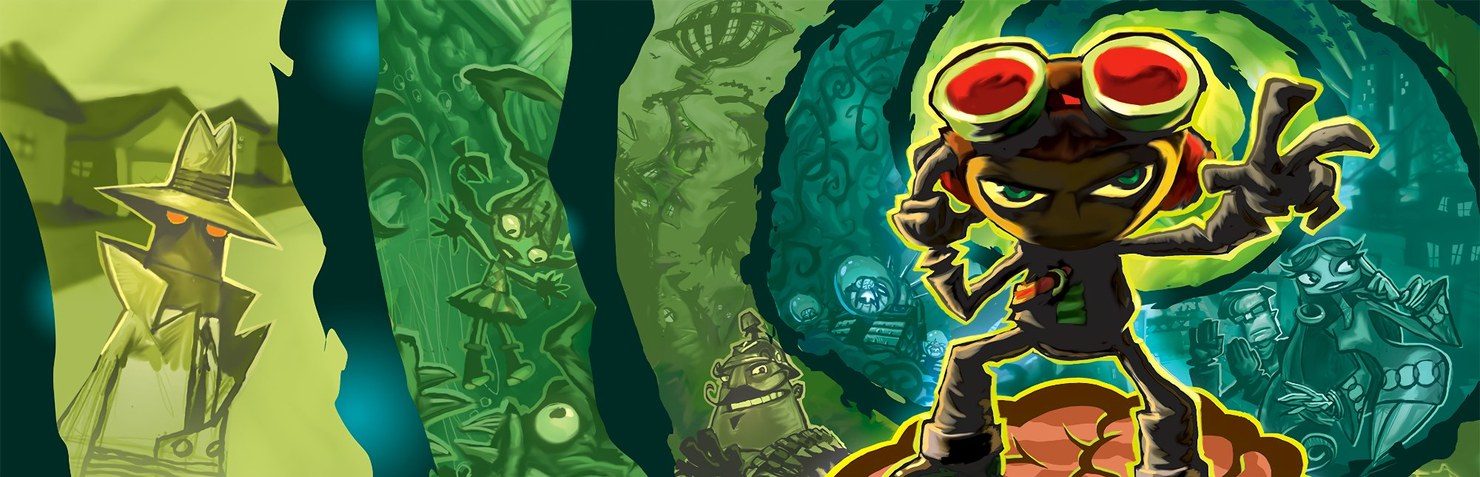
What he built with that idea is a platformer in which every level is an entirely different game. The mind of a retired military commander is a war-game diorama in miniature, soldiers and tanks the size of toys moving across a suburban tabletop. A film actor’s psyche is a perpetually burning theatre of suppressed melodrama, the architecture shifting to match his delusions. And then there is Boyd Cooper, the paranoid asylum guard, whose mind becomes the game’s most celebrated set piece: a twisted 1950s suburb where streets fold back on themselves, cameras emerge from mailboxes, and G-Men patrol the neighbourhood holding everyday props — plungers, hedge clippers, telephones — without quite knowing how to use them. The G-Men spout lines like “I cannot wait until the next payday” and “rhubarb is a controversial pie flavour,” dialogue written to sound like what an alien might calculate passes for human small talk. The suburb’s gravity shifts as Raz navigates it, pulling him onto walls and into impossible angles — the spatial representation of a mind that cannot find its bearings in ordinary reality. The premise is not metaphor. It is level design.
The Game That Nearly Didn’t Arrive
The game that produced these levels nearly didn’t reach anyone, more than once. Psychonauts was originally set to be published by Microsoft as an Xbox exclusive when development began in 2001, with Ed Fries — then vice president of game publishing at Microsoft — as its patron inside the corporation. By 2003, Microsoft threatened to cancel development unless Double Fine could demonstrate the game was working. The team delivered the Black Velvetopia level and Microsoft stayed the project — then dropped it anyway in February 2004, at what the team later described as their peak productivity. Fries had just departed the company. The new management considered Double Fine “expensive and late.”
What followed was months without a publisher. Eventually, Schafer made a call he had been dreading. Will Wright, creator of SimCity and The Sims, had recently sold Maxis to Electronic Arts. Schafer called him and offered 10% of Double Fine in exchange for a loan to make payroll. Wright’s lawyers told him the Maxis deal prevented him from owning stock in another game company. He called back and gave Schafer the money anyway — no equity, just a loan. Wright is credited for this within the finished game. By August 2004, Majesco Entertainment signed Double Fine — but on terms that meant foregoing planned hires without scaling back the game’s scope. What followed was, in the words of Double Fine’s executive producer, “the most insane crunch I have ever witnessed.”
The Publisher It Ruined
Psychonauts went gold in March 2005. The final budget was $11.5 million across 4.5 years of development. Majesco positioned it as a children’s game. The game itself is a political thriller about memory, manipulation, and the architecture of mental illness. PC Gamer awarded it their “Best Game You Didn’t Play” designation. It won Best Writing at the Game Developers Choice Awards and a BAFTA for Best Screenplay. The publisher that had saved Double Fine was then ruined by the game it had saved — Majesco suffered severe financial losses and departed the games market shortly after.
Peter McConnell, a LucasArts veteran who had scored Grim Fandango and Day of the Tentacle, composed the score. The result mirrors the level design: each mental world has its own musical grammar. Boyd’s suburb clicks and watches. Gloria’s theatre burns in strings. Oleander’s war-game miniatures move to something that sounds like a toy march. The music is doing what the levels are doing — building a character from the inside out.
The Game the Industry Couldn’t Match
The original release sold poorly. That was that — until it wasn’t. Double Fine reacquired full rights by 2011 and brought it to Steam, where it found the audience that had missed it on Xbox. By December 2015, cumulative sales reached nearly 1.7 million copies — approximately 1.2 million of them sold after the reacquisition. The game that finished its publisher went on to outsell its entire original run six times over. The sequel came eventually through Fig, and then through Microsoft, who acquired Double Fine during its development. Schafer had a ping-pong ball with an Xbox logo on his desk when he signed the 2019 acquisition paperwork — the same ball Ed Fries had given him at their first meeting, nearly two decades earlier.
What remains is a game that the industry spent fifteen years unsuccessfully trying to supersede. The sequel is excellent and changes nothing about this. The level design — every world built from a character’s specific pathology, every obstacle a projection of someone’s particular failure to think straight — has not been matched by anything that followed it. The writing still lands. Psychonauts failed commercially on its original terms. On its own terms, it has been vindicated by fifteen years of games failing to match it.
- Psychonauts — Wikipedia Wikipedia
- Classic Postmortem: Psychonauts Game Developer
- The Insane Development of Psychonauts Super Jump Magazine
- Tim Schafer on his game writing philosophy NME
- How SimCity Designer Will Wright Saved Psychonauts Kotaku
- The History of Double Fine Productions Game Informer
- The Milkman Conspiracy — The Gameological Society The Gameological Society
- How a joke about the milkman inspired Psychonauts PC Gamer