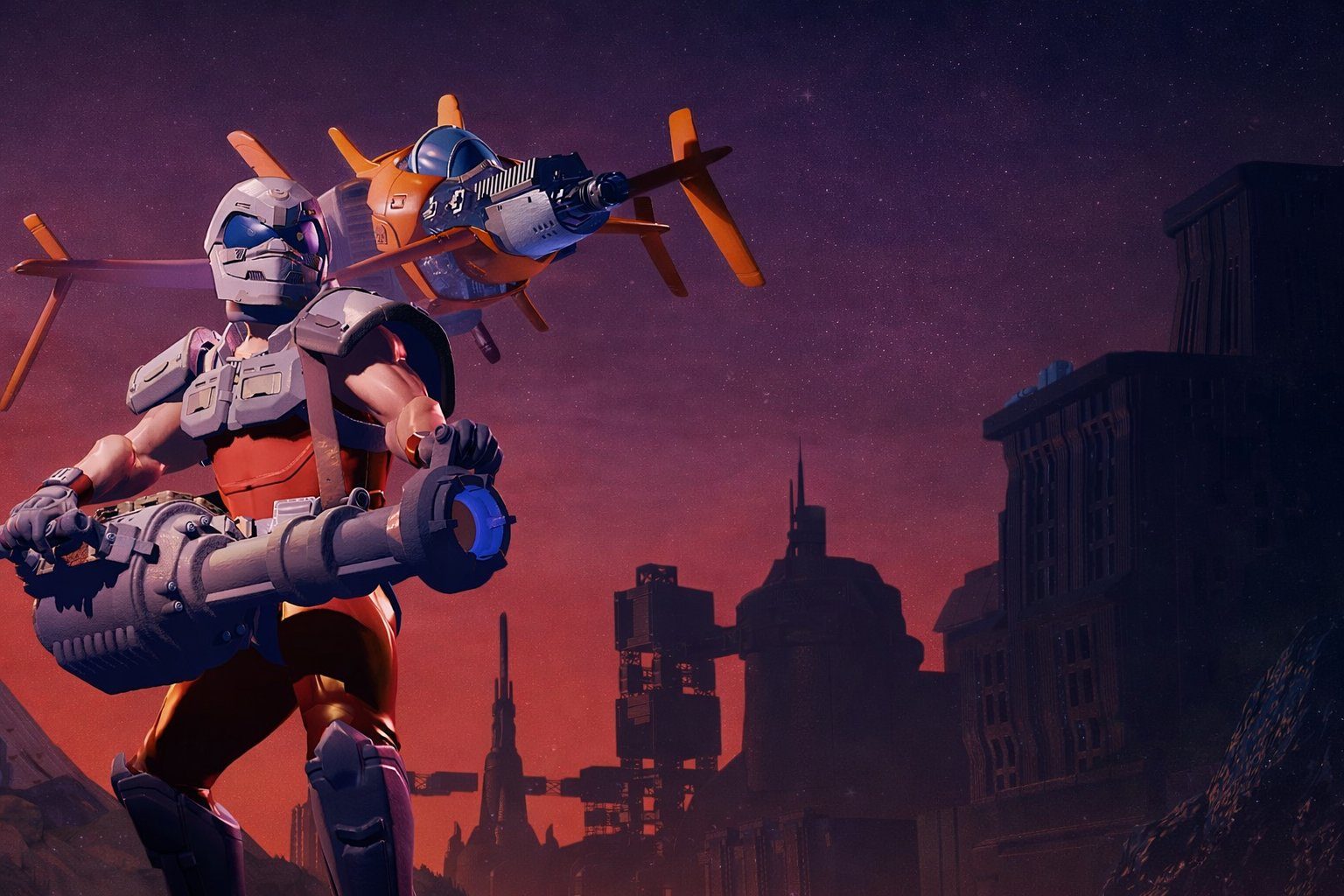
Rendering Ranger: R²
The Game That Nobody Published
Manfred Trenz had a talent for making games that nobody wanted him to make. His first significant work at Rainbow Arts was The Great Giana Sisters in 1987 — a Commodore 64 platformer so faithfully modelled on Super Mario Bros. that Nintendo sent a letter so pointed that the British distributor withdrew the game almost immediately after release. His second, Katakis, was a shoot ‘em up so close to R-Type that Activision threatened legal action — and the compromise reached was that Trenz would simply port R-Type to the C64 himself, which he did. Then he made Turrican, an entirely original run-and-gun that became one of the most celebrated games in European gaming history, and that was fine. By the time he turned his attention to the Super Famicom in the early 1990s, Trenz had spent a career making things that exceeded either the legal or the technical tolerance of the platforms around him. Rendering Ranger: R² was no different. It just had the misfortune of exceeding the market’s tolerance too.
The Project That Changed Shape
The game began, as so many of the era did, as something else entirely. The original concept was a pure horizontal shoot ‘em up — no run-and-gun sections, no boots-on-the-ground platforming, just the kind of fast horizontal shooter Trenz had been refining since Katakis. The publisher intervened. A pure shmup would be impossible to sell. Add platforming. Trenz added platforming. Then Donkey Kong Country arrived in 1994 and the industry collectively lost its mind over pre-rendered CGI sprites, so the publisher intervened again: the hand-drawn pixel art Trenz had built — which he still has in his possession, unreleased — was replaced with CGI models rendered down to sprites. The game was renamed from Targa to Rendering Ranger: R², a title that references both the pre-rendering technique and the double identity of its hero, who switches between ground soldier and fighter pilot. By the time it was finished, after nearly three years of development, only the Japanese branch of Virgin Interactive was interested in publishing it. The Western release was prepared. The Western release was never shipped.
"A technical marvel, but it was released too late and in a too-limited fashion. If it was a year earlier, maybe history would have been different."
— Audi Sorlie, Limited Run Games
What the Super Famicom Wasn’t Supposed to Do
What Trenz built in those three years is, technically, almost inexplicable. The Super Famicom was notorious among shoot ‘em up developers for slowdown — the processor simply could not handle dense sprite fields at speed, and virtually every major shmup on the platform bears the scars of that limitation. Rendering Ranger has none. Zero perceptible slowdown across nine stages, with parallax backgrounds scrolling in multiple independent layers, bosses that span the full height of the screen, and a frame rate that stays locked throughout. This was achieved not through any special chip or hardware assist but through Trenz’s assembler programming — the same low-level mastery of the hardware he had been practising since he taught himself to code on a Commodore 64 in 1984. The SNES shmup community has spent thirty years trying to understand exactly how he did it.
The game itself alternates between two modes that feel, initially, like they belong to different titles. The run-and-gun sections are tightly controlled, methodical, and unforgiving in the best sense — eight-directional shooting, environmental hazards, a weapon upgrade system that changes your tactical calculus entirely depending on which gun you’re carrying. The shooter sections, where the screen becomes a horizontal kill-zone of layered fire and spiralling enemy formations, are something else altogether: pure velocity, muscle memory, the kind of flow state that only the best examples of the genre induce. The transition between the two modes is jarring at first and then becomes the whole point — each mode sharpens your appreciation of the other, and the pacing across the nine stages is handled with the discipline of a developer who had been building shooters for a decade and knew exactly what he was doing.
A Game That Arrived Too Late
It arrived on November 17, 1995. The PlayStation was already on the market. The Nintendo 64 was months away. Nobody was interested in a 2D Super Famicom game, however extraordinary its technical execution. Ten thousand copies were pressed. Most of them sat in warehouses. The game accrued its reputation slowly, through import collectors and emulation forums and the occasional mention in specialist magazines, until the original cartridge became one of the rarest Super Famicom titles in existence. One of the men who made it — Rainbow Arts composer Chris Hülsbeck, who had scored every major Trenz project since Giana Sisters — was not involved with Rendering Ranger, which is worth noting simply because his absence is so conspicuous. The soundtrack is adequate. The game is extraordinary despite it.
The Re-release and What It Fixed
Trenz himself declined to participate in the re-release. Ziggurat Interactive, who acquired the rights to over eighty Rainbow Arts titles in 2021 and 2022, brought the game to modern platforms as Rendering Ranger: R² [Rewind] — with the original Targa prototype, the hand-drawn sprite version that preceded the CGI overhaul, included for comparison. Hülsbeck contributed a new remix for the menu. The game is now accessible for the first time to the Western audience it was always intended for. What they find is a game built on a hardware platform at the moment of its maximum capability, by a developer who had been exceeding expectations his entire career, for a market that had already turned its back. It plays like an argument that the market was wrong.
Platform: Super Famicom (Japan only, 1995) · Now available as Rendering Ranger: R² [Rewind] on Nintendo Switch, PlayStation 4/5, PC via Steam and GOG
Best played: The Rewind re-release on any modern platform — it includes the original game, the Targa prototype, and a development retrospective. The original Super Famicom cartridge is one of the rarest in existence; a physical SNES re-press was available through Limited Run Games in 2022.
Time to complete: 2–3 hours · short, demanding, best learned over multiple runs.
Why now: Because this is what 16-bit hardware looked like at its absolute technical ceiling, built by the man who also made Turrican, and it has been inaccessible to most players for thirty years. The Rewind re-release has finally closed that gap. Go in knowing the run-and-gun and shooter sections feel distinct — that’s the design, not a flaw — and let the game build its case.
- Rendering Ranger: R² — Wikipedia Wikipedia
- Rendering Ranger R2 — HG101 HG101
- Manfred Trenz interview — Unseen64 Unseen64
- Rendering Ranger R2 — SNES Central SNES Central
- Limited Run Games release announcement Limited Run Games
- Manfred Trenz portfolio Manfred Trenz
- Turrican series history — HG101 HG101
- Rainbow Arts — MobyGames MobyGames