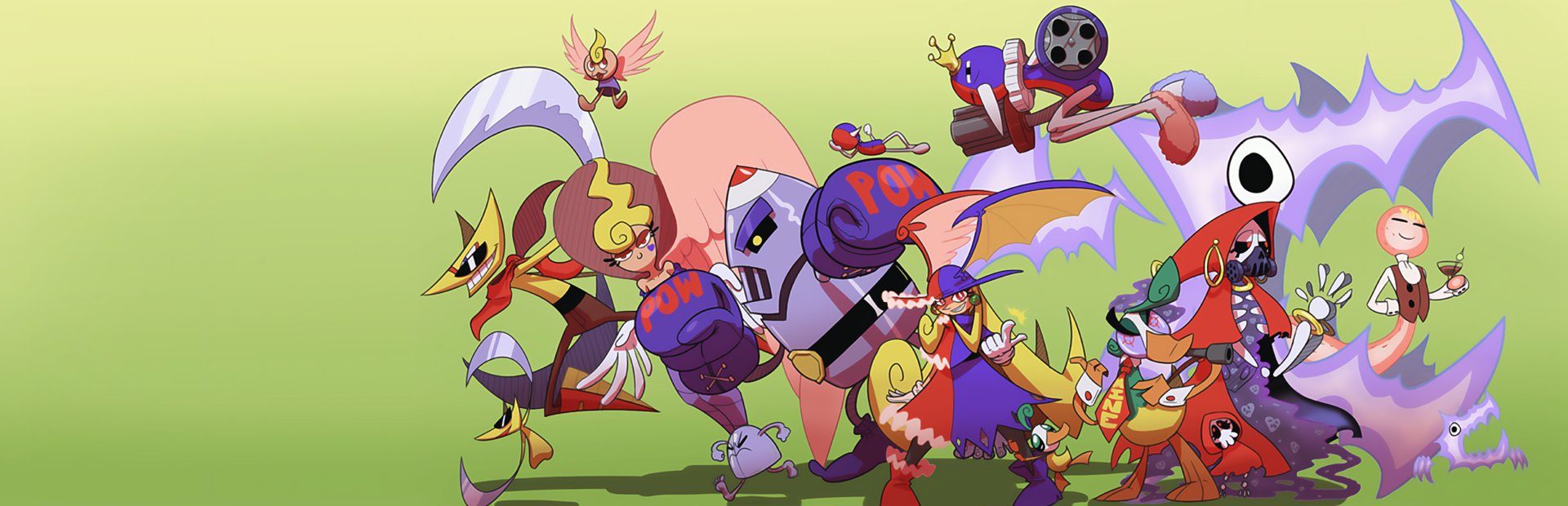
Silhouette Mirage
Both Sides of the Blade
Treasure make games about a single idea — one design concept taken further than anyone else has tried to take it. Gunstar Heroes was about what happens when you make every weapon a combination of every other weapon. Radiant Silvergun was about what happens when you give a shoot ‘em up seven distinct weapon systems and make all seven useful. Silhouette Mirage, released on the Saturn in Japan in September 1997, was about what happens when the direction you face is the most important decision you make in a fight. The result is an action game that plays unlike anything else in the studio’s catalogue — and that, for almost three decades, Western players had no clean way to access.
One Body, Two Attributes
The concept came from director Masaki Ukyo, who wanted an action game built around two opposing attributes and make the tension between them tactile rather than cosmetic. The solution is still elegant in the abstract: Shyna Nera Shyna, the protagonist, embodies both attributes simultaneously, her body split down the middle. She is Silhouette when facing left. She is Mirage when facing right. Enemies are one or the other, and only opposing attributes deal damage to their life gauge — same-attribute attacks drain an enemy’s spirit meter, weakening their offence, but leave their health intact. Getting into the correct facing relative to the thing trying to kill you is the game’s central problem. Ukyo described the grabbing, throwing, and repositioning system the team added as something they included simply because they liked it; it became the heart of how fights unfold.
The spirit meter adds a second layer drawn from what Treasure had developed for Guardian Heroes the previous year. Every combatant carries two bars: a life gauge that kills them when it empties, and a spirit gauge whose depletion weakens attacks. Drain a powerful enemy’s spirit before finishing them and their assault becomes manageable; let your own spirit run down and you’re left with your weakest available shot. Ukyo described the development process as one where ideas that felt good were added — the cash-bashing grapple that shakes money from enemies, the parasite weapon pickups, the reflector shield that sends incoming fire back at the correct attribute. The question of whether these ideas balanced into something coherent was answered, in the Saturn version, in the affirmative.
The Game Underneath the Combat
What you’re doing across seven stages is something closer to a sequence of spatial puzzles than a traditional run-and-gun. Each screen presents enemies of different attributes in different positions, and the challenge is arranging your body relative to theirs without presenting your matching side to the fire coming back. Shyna can run along walls and ceilings, triple jump, grab enemies and spin them into their companions, reflect projectiles if her current attribute matches the shot. The moment the system fully arrives — the moment you stop thinking in terms of left and right and start reading the battlefield as a colour arrangement to be corrected — the game changes entirely. It becomes quick, even fluid, in a way the early stages don’t advertise.
The pacing of the Saturn version rewards aggressive positioning. Working Designs' localisation rewarded something else entirely — a slow, grinding style of play the design had never been built to accommodate.
What Working Designs Did to It
Western audiences encountered that design only in its disrupted form. Working Designs, the California publisher who handled the North American PlayStation release, shipped the game in January 2000 with a set of alterations that compounded across the entire experience. Shop prices were raised. Enemy damage output was increased. Every attack now drained Shyna’s spirit gauge — a cost that simply didn’t exist in the Japanese versions, and that forced the combative rhythm into something slower and more attritive. GameSpot’s review recommended importing the original Saturn release, writing that the changes had made an enjoyable game into something tedious. It was a sharp verdict, and an accurate one.
The script changes ran deeper than the economy. Every name in Silhouette Mirage’s world draws from religious tradition — Megido, Gehena, Hal, the protagonist’s companion Moses, who fights for Shyna’s cause despite being born of the Mirage faction, a mirror of his namesake’s defection from the Egyptians who raised him. Working Designs changed Moses to Bug, stripped the Biblical framing throughout, and altered dialogue in ways that erased the allegorical structure the story had been built on. The characters remained; their meaning was removed. ## Finally Available as It Was Meant to Be
It wasn’t until 2024 that a fan retranslation by Wiredcrackpot, working directly from the original Japanese script, finally gave English-speaking players access to the story Treasure had written — names, allegory, and thematic logic intact.
Two patches now exist for the Saturn version: one that ports Working Designs’ English text without the difficulty changes, and one that translates from the Japanese directly. Between them, the game Treasure made in 1997 is more accessible now than it was at any point during the era it was released. The polarity concept Ukyo developed here was rigorous enough that Hiroshi Iuchi drew on it directly when designing Ikaruga four years later — transposing the facing-dependent attribute system from a side-scrolling action game to a vertical shoot ‘em up and arriving at something many players now consider Treasure’s masterpiece. Ikaruga is celebrated. Silhouette Mirage is still discussed largely in the context of what happened to it. The game underneath that story is precise, spatially demanding, and genuinely unlike the rest of the studio’s catalogue.
Shyna’s body, red on one side and blue on the other, is the game in miniature. To carry both attributes at once and deploy only the relevant one — to be capable in both directions while constrained by nothing except your own positioning — is an idea that still hasn’t been fully explored elsewhere. What Treasure built in 1997 and Working Designs obscured in 2000, the fan translation community has been restoring. The game is available now in the form it was meant to take. The direction you face remains the most important thing.
- Silhouette Mirage — Wikipedia Wikipedia
- Silhouette Mirage — Hardcore Gaming 101 Hardcore Gaming 101
- The Cutting Room Floor — PS1 Regional Differences The Cutting Room Floor
- Fan Retranslation Patch — SegaXtreme SegaXtreme
- Ikaruga — Wikipedia Wikipedia (polarity system lineage)