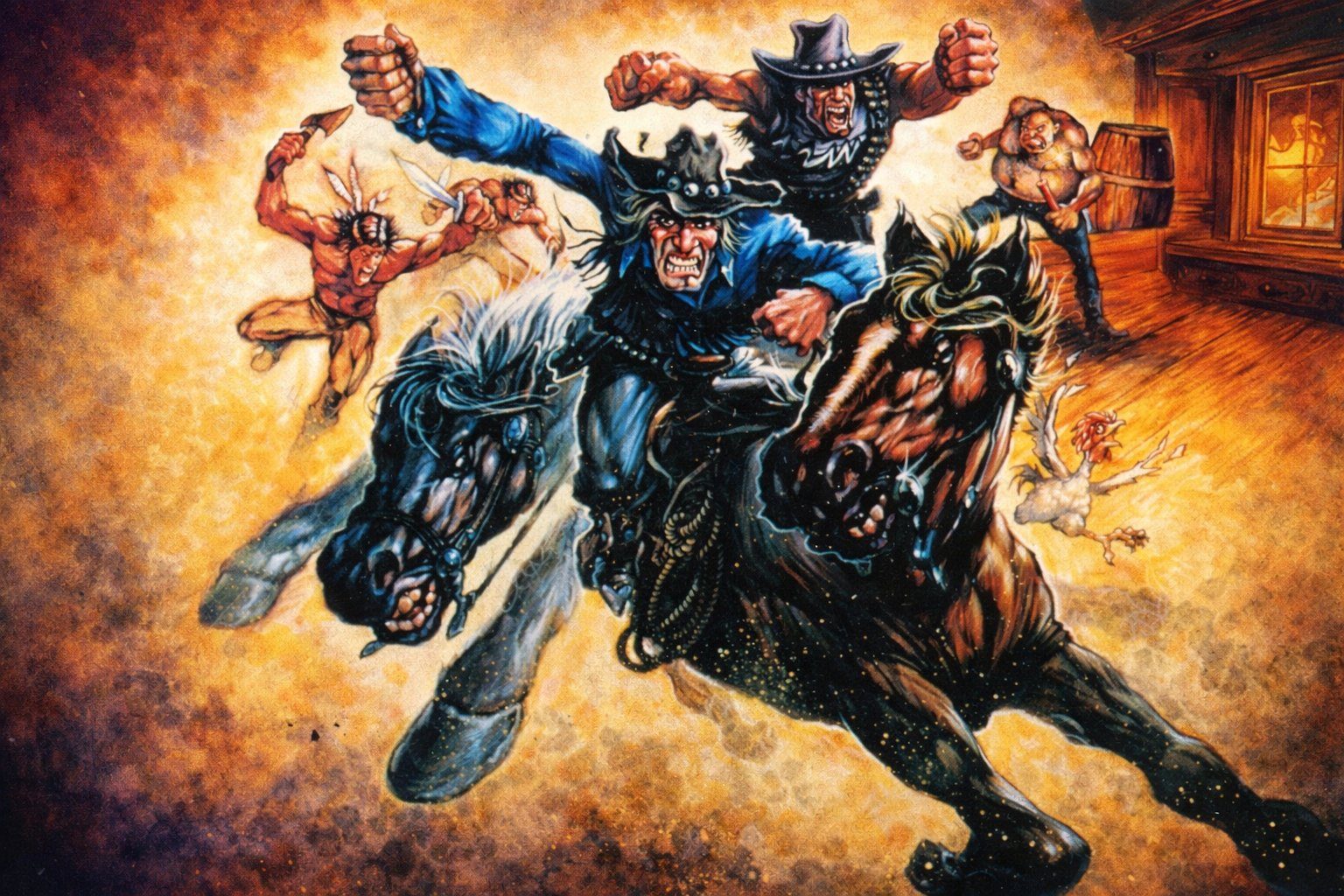
Sunset Riders
Bury Me With My Money
Hideyuki Tsujimoto had already made a very good Contra game — the arcade Super Contra, faster and more precise than the home version most players know. When Konami tasked him with riding the wave of their four-player TMNT cabinet, he didn’t reach for a franchise. He reached for the Western. The result was Sunset Riders: four bounty hunters, eight outlaws, one corrupt English aristocrat pulling the strings, and a score mechanic built around the dollar value of every criminal you bring down. The thesis of the game is on every Wanted poster that opens each stage. You are not here to save the world. You are here to get paid.
Four Characters, Four Choices
The four characters are meaningfully distinct in weapon feel and crowd-control profile. Steve and Billy carry revolvers — fast rate of fire, tight spread, two guns with the right power-up. Bob runs a rifle, slower but hitting harder and slightly farther. Cormano carries a double-barrel shotgun, the widest spread in the game, devastating at close range. The arcade cabinet came in two variants: a two-player version where you chose your character, and a four-player version where each character was assigned to a fixed control panel. In the four-player version you don’t choose — you take whoever’s left. That constraint changes the social dynamic entirely. Suddenly Cormano’s shotgun isn’t a preference; it’s your assignment, and the conversation around it is half the entertainment.
Eight Outlaws, Eight Wanted Posters
Most of the game’s personality lives in its bosses. Simon Greedwell opens proceedings, a man whose name announces his sin. Hawkeye Hank Hatfield follows. Then El Greco on a runaway train, then Paco Loco with his gatling gun, then the Smith Brothers as a dual boss in a saloon chandelier fight, then Chief Scalpem, then Dark Horse on his armoured stallion, and finally Sir Richard Rose — an English villain in a top hat with a steel plate under his waistcoat, who you must shoot through twice. Each boss enters with a wanted poster, a bounty value, and enough personality to make the fight feel like a confrontation rather than an obstacle. When you defeat El Greco while playing as Cormano, the dying boss throws his red sombrero into the air and Cormano catches it and wears it for the rest of the game. It is a charming bit of character animation, and it shows a team that had genuine affection for what they were making.
"Bury me with my money."
— Simon Greedwell, upon defeat, Stage 1
Two Buttons, Eight Directions
Playing it today, what holds up is the precision and legibility of the movement. Two buttons — shoot and jump — with eight-direction aiming, a slide that gets you under incoming fire, and the ability to jump between two tiers of platform without breaking pace. The bullet feedback is exactly right: enemies stagger, react, collapse with weight. The multi-directional shooting and lane-switching integrate cleanly into set-pieces that are always readable at speed — you understand where the threat is and how to answer it. The stage scenarios rotate through everything the Western genre contains — gunfights in saloons, chases on horseback, running along the backs of stampeding buffalo, a train pursuit, a mountain pass, a final mansion assault. None of it outstays its welcome. A full run takes under an hour.
What a modern player will notice is how constantly the game changes the problem. This is not a game that finds one loop and runs it eight times. Each stage environment introduces new hazards, new enemy behaviours, new boss mechanics. The variety is the argument. An hour with Sunset Riders does not feel repetitive because it genuinely is not.
Composer Motoaki Furukawa’s soundtrack is precise enough to have warranted its own Japanese album release in 1992. Each stage has a theme that shifts with the action — the town level canters, the train chase drives, the saloon confrontations drop into something closer to a showdown. The music doesn’t comment on the game; it is the game’s mood, moment to moment.
The honest caveat: Sunset Riders is still an arcade game built around memorisation and repetition. First runs will include deaths that feel unfair — a boss attack with a tight tell, an enemy spawning from off-screen, a jump that reads badly in the heat of a chase. It is not frictionless. It is a coin-op, and some of that coin-op calculus is still present. But the friction is short-lived. A run is under an hour. What you learn sticks. The second run is better than the first, and the third is better still.
The Name That Came From a Sales Meeting
The European prototype named the Mexican character “Hermano” — Spanish for “brother.” When Konami’s Japanese managers brought it to their Italian distributor near Milan, a technician jokingly suggested renaming him after the small town where the company was based: Cormano. The name stuck through to final release. The game is full of small accidents that calcified into something permanent.
Why the Arcade Version Is the Only Version
The SNES port is the most faithful home version: all four characters, all eight stages, the music intact. Nintendo of America’s requirements changed stage 6’s Native American enemies, replacing them with generic outlaws and renaming Chief Scalpem as Chief Wigwam. The Japanese Super Famicom version left stage 6 intact — the changes were American, not global. The Genesis port restructures more substantially: two characters, four bosses, redesigned stages. Avoid it. The arcade original — available through Hamster’s Arcade Archives on Switch and PS4 — remains the cleanest version of what Tsujimoto built, and the SNES version the best home alternative.
Simon Greedwell is the first boss. He falls off his balcony, coins spilling around him, and says: “Bury me with my money.” The game tells you everything you need to know about itself in the first ten minutes. Fast, legible, funny, greedy, and done before it overstays its welcome. That combination is rarer than it sounds, and it is why Sunset Riders is still here.
- Sunset Riders — Wikipedia Wikipedia
- Sunset Riders — Hardcore Gaming 101 Hardcore Gaming 101
- Sunset Riders — Arcade History Arcade History (Cormano naming, credits)
- Sunset Riders SNES Review — Nintendo Life Nintendo Life
- Sunset Riders — Konami Wiki Konami Wiki
- Mystic Warriors — Wikipedia Wikipedia (same team, spiritual successor)