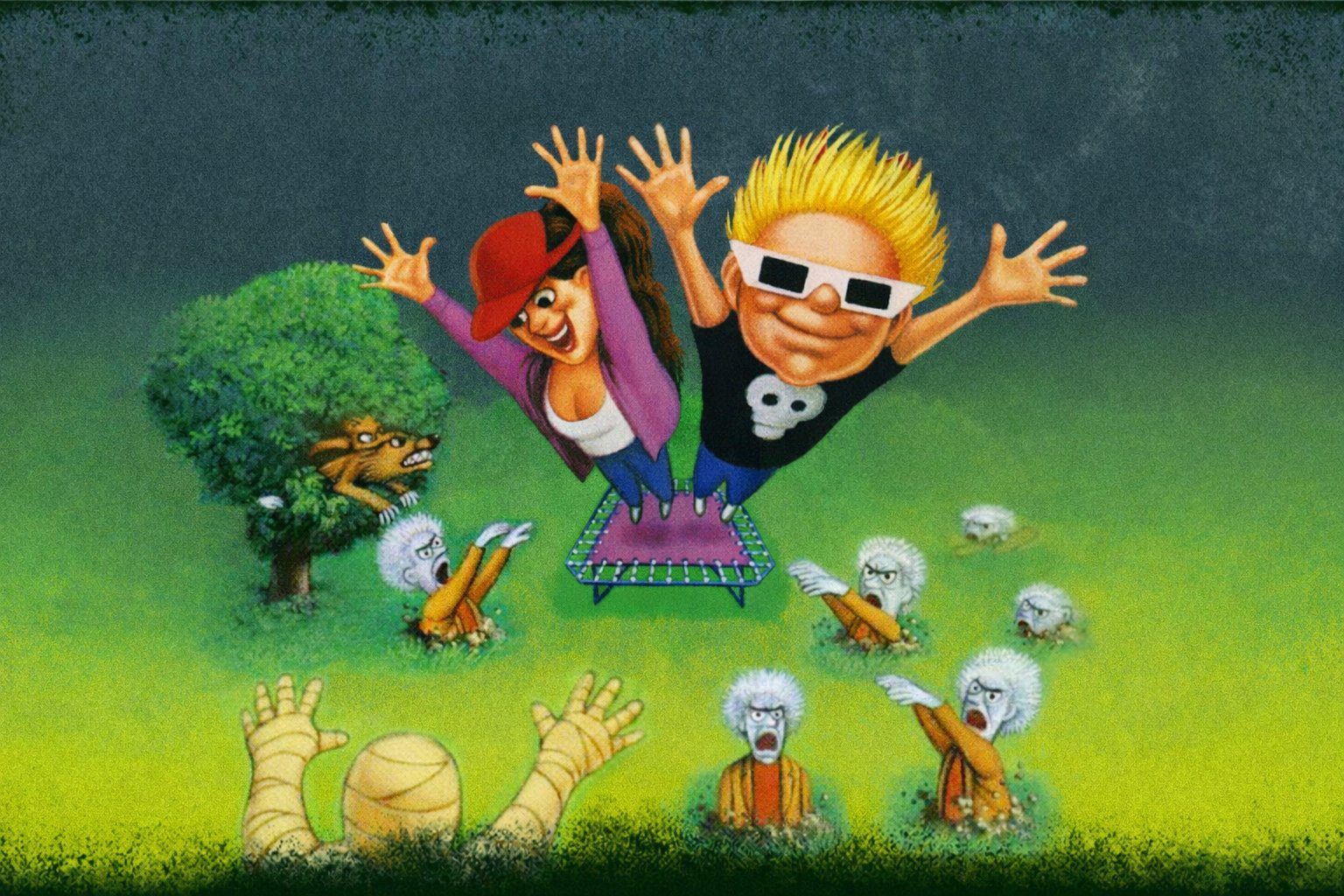
Zombies Ate My Neighbors
The Adventure Game Company's Secret
Mike Ebert arrived at LucasArts as an artist, working on the NES port of Maniac Mansion. He moved through Indiana Jones and into The Secret of Monkey Island, learning the craft of comedic game design under Ron Gilbert. But what Ebert wanted to make wasn’t an adventure game. He was a fan of Robotron and Smash TV — twin-stick arcade shooters where the screen filled with enemies and survival was a matter of reflexes and movement. Working in his spare time, he began tinkering with a graphics engine a colleague had written — making strange demos, prototypes, experiments. One of them was a top-down game about saving people from monsters. That demo became Zombies Ate My Neighbors. The working title was simply “Monsters.”
An Encyclopaedia of Horror Cinema as Level Design
The concept was exactly as direct as it sounds. Ebert drew his monster roster from the B-movies he’d grown up watching on a San Francisco Saturday night horror show — the ones that played the worst films available, cheerfully, to teenagers who wanted to be scared and laugh at the same time. Zombies, mummies, werewolves, chainsaw maniacs, blobs, pod people from Invasion of the Body Snatchers, Creature from the Black Lagoon analogues, evil dolls that clearly owe something to Child’s Play. LucasArts had a legal team experienced in exactly how far parody could be pushed, and Ebert pushed it. Weapon effectiveness was designed around film logic: silverware kills werewolves in a single hit, holy water accelerates vampire deaths, the crucifix has its uses. Level names riff on films and culture — “Dances with Werewolves,” “Seven Meals for Seven Zombies,” “Weird Kids on the Block.” One secret level is an explicit reference to Day of the Tentacle. The final level takes place inside LucasArts’ own offices, where George Lucas himself appears as a cartoon character.
The Rescue Mechanic and Why It Matters
What makes it still worth your time is the rescue mechanic — the thing that separates it from every other run-and-gun of the era. The lineage Ebert cited was Robotron and Smash TV, but the deeper structural debt is to Gauntlet: multi-screen exploration, survival pressure, resources bleeding away in real time. What Zombies Ate My Neighbors adds is consequence. At the start of each level, a fixed number of neighbours are alive and scattered across the map. Neighbours who die are gone permanently, and the total carries forward: if your count drops to zero at any point in the game, it’s over. It isn’t just a shooter — it’s a resource triage system wearing a shooter’s clothes. Every level is a question of prioritisation under pressure: which neighbours can you reach, which are already lost, how much ammunition are you burning to save someone who won’t matter in the long run. The team wanted battery save support but couldn’t afford it, so a password system stayed — which means the long-form pressure isn’t purely design philosophy. The game is partly brutal because it couldn’t afford to be kinder. Because that count carries forward regardless, it quietly becomes a long-form survival run rather than a series of discrete levels — accessible in its first hour, genuinely brutal by its midpoint, requiring map knowledge and resource discipline that a single session can’t teach. Ebert planned the first twenty levels to each feel distinct, knowing that if he could hook players through those, the repetition that followed would be forgiven — and across 55 levels in total, it holds for most of them. In two-player co-op — the way it was designed to be played — the dynamic shifts entirely: split rescue routes, shared weapon economy, one player covering while the other retrieves. What solo presents as an optimisation puzzle becomes, with a second player, something closer to emergent coordination.
The weapons are the game’s second delight. A water pistol is your starting equipment, which tells you everything about the register Ebert was aiming for. It escalates from there to bazookas, weed whackers, exploding soda cans, tomatoes, popsicles, ancient artefacts, and silverware thrown like shuriken. Each enemy type has a preferred counter, which means choosing what to carry into each level is a genuine strategic question. Go in with the wrong loadout against a vampire nest and you’ll burn resources you needed for the chainsaw maniacs two screens later. Some levels add a further layer: as time passes, tourists transform into werewolves — neighbours you might have reached become threats you now have to manage. Triage operates in space and in time simultaneously.
The Afterlife
The publishing deal with Konami returned very little in royalties despite strong reviews, and LucasArts let the game recede with a speed that, in retrospect, was structural rather than accidental. The company’s identity was built around the SCUMM adventure engine and the Star Wars licence; anything outside those pillars had no internal champion and no long-term institutional memory. What few people noticed at the time was that the game’s engine quietly powered several subsequent LucasArts titles — Ghoul Patrol, Metal Warriors, Big Sky Trooper — a hidden action branch running parallel to SCUMM, unacknowledged and ultimately abandoned. Zombies Ate My Neighbors wasn’t forgotten because it failed — it was forgotten because it had nowhere to belong. Ebert and programmer Dean Sharpe left to found Big Ape Productions, making Herc’s Adventures — the same design with a Greek mythology flavour — for LucasArts in 1997, a refinement that gestured at what the formula could become. When someone later approached LucasArts about a re-release, the response was: “We made that game?” The re-release happened anyway — the Wii Virtual Console in 2009, then the Lucasfilm Classic Games collection on Switch, PS4 and PC in 2021. Thirty years on, it remains one of the few games from that era that rewards playing rather than remembering — the best thing LucasArts made that nobody there seemed to recall.
Platform: SNES and Mega Drive (1993) · Available now: Lucasfilm Classic Games: Zombies Ate My Neighbors and Ghoul Patrol on Nintendo Switch, PS4, Xbox One, and PC
Best played: The modern collection is the practical choice — both versions of the game, legally accessible, on current hardware. SNES and Mega Drive originals are broadly comparable; the SNES version has a flamethrower the Mega Drive lacks, the Mega Drive version has the more satisfying blood effect on game over.
Time to complete: 4–6 hours to reach the end; considerably longer to survive all 48 levels with neighbours intact. The password system means you can step away and return.
Why now: Because the rescue mechanic — neighbours dying permanently, the count carrying forward, every level a triage problem — is a genuine design idea that holds up entirely. And because a game this warm, this funny, and this knowingly B-movie deserves to be understood as what it actually was: the best thing LucasArts made that nobody at LucasArts remembered making.
- Zombies Ate My Neighbors — Wikipedia Wikipedia
- Zombies Ate My Neighbors — HG101 HG101
- LucasArts history — The Digital Antiquarian The Digital Antiquarian
- Zombies Ate My Neighbors — GameFAQs GameFAQs
- Zombies Ate My Neighbors & Ghoul Patrol — Retrobit release Retro-Bit
- George Sanger / Fat Man — ZAMN soundtrack notes The Fat Man